XIAO ESP32-C3
Seeed's 21 x 17.8 mm ESP32-C3 board with Wi-Fi, Bluetooth LE 5, LiPo charging and an external antenna.
- ChipESP32-C3, single-core 32-bit RISC-V, up to 160 MHz
- Memory400 KB SRAM, 4 MB flash
- Wireless2.4 GHz Wi-Fi 802.11b/g/n, Bluetooth 5 (LE) with mesh, U.FL external antenna
- GPIO11 pads, D0 to D10, all PWM capable; 4 analog (A0 to A3)
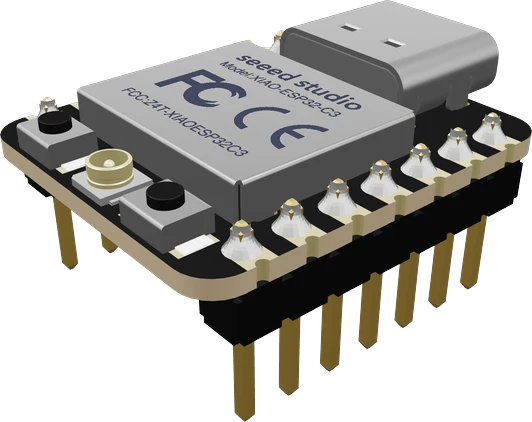
The Seeed Studio XIAO ESP32C3 is a 21 x 17.8 mm board with Espressif's ESP32-C3 (single-core RISC-V at up to 160 MHz, 400 KB SRAM, 4 MB flash), 2.4 GHz Wi-Fi and Bluetooth 5 (LE) (Seeed XIAO ESP32C3 wiki, specifications). Power it with 5 V over USB-C or a 3.7 V LiPo on its battery pads, and wire parts to its 11 GPIO pads D0 to D10 at 3.3 V; use A0 to A2 for analog reads, since A3 sits on ADC2 and can return unreliable samples (Seeed wiki). It has no user LED, so wire one to a free pad.
The XIAO ESP32C3 is Seeed Studio's thumbnail-sized ESP32-C3 board in the XIAO form factor: 21 x 17.8 mm, with castellated pads along both long edges so it can be soldered flat onto a carrier board or fitted with headers for a breadboard. It has a USB-C port, BOOT and RESET buttons, a U.FL connector with an external antenna in the box, a charge LED and battery pads with a built-in LiPo charger (Seeed XIAO ESP32C3 wiki).
The chip is Espressif's ESP32-C3: a single-core 32-bit RISC-V CPU at up to 160 MHz with 400 KB of SRAM, 2.4 GHz 802.11b/g/n Wi-Fi and Bluetooth 5 (LE) with mesh (ESP32-C3 datasheet v2.4, pp. 3, 4; Seeed wiki). There is no Bluetooth Classic. The USB-C port is the C3's own USB Serial/JTAG controller, so there is no separate USB-to-serial chip, and Serial in Arduino goes over that USB link.
Eleven pads, D0 to D10, are GPIO and can all output PWM; D0 to D3 are analog-capable, with Seeed recommending A0 to A2 (ADC1) for reliable readings because A3 uses ADC2 (Seeed wiki). The board is built for battery projects: it charges a 3.7 V lithium cell at up to 380 mA and draws about 44 µA in deep sleep (Seeed wiki, specifications). There is no on-board user LED; the only LED is the charge indicator.
XIAO ESP32-C3 pinout
| Pin | Function | Type |
|---|---|---|
| D0 | Digital, PWM, ADC1_CH2, strapping3.3 V | bidirectional |
| D1 | Digital, PWM, ADC1_CH33.3 V | bidirectional |
| D2 | Digital, PWM, ADC1_CH43.3 V | bidirectional |
| D3 | Digital, PWM3.3 V | bidirectional |
| D4 | Digital, PWM, I2C SDA3.3 V | bidirectional |
| D5 | Digital, PWM, I2C SCL3.3 V | bidirectional |
| D6 | Digital, PWM, UART TX3.3 V | bidirectional |
| 5V | 5V / VBUS | power in |
| GND | GND | power in |
| 3V3 | 3V33.3 V | power out |
| D10 | Digital, PWM, SPI MOSI3.3 V | bidirectional |
| D9 | Digital, PWM, SPI MISO, strapping3.3 V | bidirectional |
| D8 | Digital, PWM, SPI SCK, strapping3.3 V | bidirectional |
| D7 | Digital, PWM, UART RX, SPI SS3.3 V | bidirectional |
Specifications
- Chip
- ESP32-C3, single-core 32-bit RISC-V, up to 160 MHzSeeed XIAO ESP32C3 wiki, specifications; Espressif ESP32-C3 datasheet v2.4, p. 3
- Memory
- 400 KB SRAM, 4 MB flashSeeed XIAO ESP32C3 wiki, specifications
- Wireless
- 2.4 GHz Wi-Fi 802.11b/g/n, Bluetooth 5 (LE) with mesh, U.FL external antennaSeeed XIAO ESP32C3 wiki, specifications
- GPIO
- 11 pads, D0 to D10, all PWM capable; 4 analog (A0 to A3)Seeed XIAO ESP32C3 wiki, pin map
- Power input
- 5 V on USB-C or the 5V pin; 3.7 V on the battery padsSeeed XIAO ESP32C3 wiki, specifications
- 3V3 output
- 500 mA maximumSeeed XIAO ESP32C3 wiki, specifications
- Battery charging
- 380 mA fast charge, 40 mA trickleSeeed XIAO ESP32C3 wiki, specifications
- Deep sleep current
- About 44 µASeeed XIAO ESP32C3 wiki, specifications
- Dimensions
- 21 x 17.8 mmSeeed XIAO ESP32C3 wiki, specifications
- Operating temperature
- -40 °C to 85 °CSeeed XIAO ESP32C3 wiki, specifications
- Logic level
- 3.3 V
- Clock speed
- 160 MHz
- Flash
- 4 MB
- RAM
- 400 KB
- GPIO pins
- 11
- ADC channels
- 3
- ADC resolution
- 12 bits
- PWM channels
- 6
- Bluetooth
- BLE 5.0
- Weight
- 3 g
From the Seeed Studio's datasheet, published by Seeed Studio.
Common mistakes
Looking for the built-in LED
The XIAO ESP32C3 has no user LED and no LED_BUILTIN; the only LED is the charge indicator (Seeed wiki). Wire an LED with a series resistor to a free pad; Seeed's blink example uses D10.
Analog sensor on A3
A3 (D3, GPIO5) uses ADC2, which Seeed warns may give unreliable samples (Seeed wiki). Put analog sensors on A0, A1 or A2.
Wrong battery
The charger is for a single 3.7 V lithium cell (Seeed wiki). A 2S pack, a 9 V battery or AA cells on the battery pads will damage the board.
Blocking on while (!Serial) on battery
Serial runs over the C3's native USB. A sketch that waits for the port to open never starts when the board runs from a battery. Add a timeout to the wait.
Forgetting the antenna
Wi-Fi and Bluetooth range depend on the external antenna on the U.FL connector (Seeed wiki). Clip it on before testing range.
XIAO ESP32-C3 questions
Is the XIAO ESP32C3 5 V tolerant?
No. The pads run at 3.3 V and the ESP32-C3 rates its inputs to VDD + 0.3 V (ESP32-C3 datasheet v2.4, p. 55). The board takes 5 V on USB-C or the 5V pin, but every signal must be 3.3 V.
Why won't my XIAO ESP32C3 upload or show up?
Press RESET once with the board connected. If it still is not found, hold BOOT, plug in the USB-C cable while holding it, then release BOOT to enter bootloader mode (Seeed wiki, FAQ). Use a USB-C cable that carries data.
Does the XIAO ESP32C3 have a built-in LED?
No user LED. The board's only LED shows charging status, and there is no LED_BUILTIN (Seeed wiki). Connect an LED with a resistor to a free pad such as D10.
How do I power the XIAO ESP32C3 from a battery?
Solder a 3.7 V lithium cell to the battery pads on the back; the board charges it at up to 380 mA from USB (Seeed wiki, specifications). Deep sleep draws about 44 µA, which suits long-running battery sensors.
XIAO ESP32C3 vs ESP32-C3 SuperMini?
Both use the ESP32-C3. The XIAO adds a LiPo charger, an external U.FL antenna and Seeed's documentation but has 11 GPIO and no user LED (Seeed wiki); the SuperMini has 13 GPIO, a chip antenna and a blue LED on GPIO8, without battery charging.
XIAO ESP32C3 vs ESP8266 boards?
The XIAO ESP32C3 adds Bluetooth 5 (LE), native USB, battery charging and a 160 MHz RISC-V core with 400 KB SRAM (Seeed wiki). For new Wi-Fi projects it does more in a smaller footprint; an ESP8266 board makes sense mainly to reuse existing code.
Build something with the XIAO ESP32-C3
- Build this
Battery-powered Wi-Fi sensor
Read a sensor, publish it to MQTT and deep sleep between readings on a small LiPo.
- Build this
BLE wearable
Stream motion or heart-rate data to a phone over Bluetooth LE from a coin-sized board.
- Build this
Home Assistant node with ESPHome
Flash ESPHome to report switches, sensors and relays into Home Assistant.
- Build this
Remote door or window sensor
Wake on a reed switch, send a notification over Wi-Fi and sleep again.
This page as plain Markdown, for ChatGPT, Claude or your own agent. /components/xiao-esp32-c3.md