TM1637 4-Digit Display with an ESP32 DevKit V1
A red 4-digit 7-segment display with a center colon, driven by the Titan Micro TM1637 chip over just two signal wires.
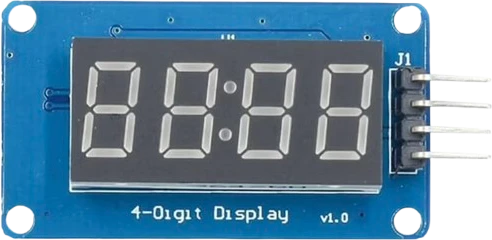
On the ESP32 DevKit V1 the page runs the TM1637 display from VIN's 5 V, with CLK on GPIO13 and DIO on GPIO14 through a bidirectional level shifter, bit-banged by the library. Any two output-capable GPIOs work, since the TM1637's two-wire link has no address and uses no I2C controller.
Wiring the TM1637 4-Digit Display to the ESP32 DevKit V1
Pin by pin.
| TM1637 4-Digit Display | ESP32 DevKit V1 | Note |
|---|---|---|
| CLK | GPIO13 (D13) | through a level shifter (a BSS138 board): the module pulls CLK up to its 5 V |
| DIO | GPIO14 (D14) | through a level shifter (a BSS138 board): the module pulls DIO up to its 5 V |
| VCC | VIN | |
| GND | GND |
- VCC is on VIN, which gives about 5 V only while the board is powered from USB.
- The TM1637 is rated for a 4.5 to 5.5 V supply and reads a high from 0.7 × VDD (3.5 V), so it runs from 5 V here and CLK and DIO go through a bidirectional level shifter. Powered from 3.3 V many modules light, but outside the datasheet's range.
What to know on the ESP32 DevKit V1
- The TM1637 is specified for 4.5 V to 5.5 V, which is why VCC goes to VIN, about 5 V while the DevKit runs from USB. On 3V3 many modules still light, but outside that rating and often dimmer.Titan Micro TM1637 datasheet V2.1, p. 2
- At 5 V the chip wants 0.7 x VDD, 3.5 V, for a high, and its pull-ups would put 5 V on the ESP32's pins, so CLK and DIO each pass through a BSS138 shifter. It must work both ways, because the chip drives DIO itself during its acknowledge.Titan Micro TM1637 datasheet V2.1, pp. 2, 14; Espressif ESP32 Series Datasheet v5.3, p. 52
- Keep CLK and DIO off the input-only GPIO34 to GPIO39 and off the strapping pins GPIO0, 2, 5, 12 and 15. GPIO13 and GPIO14 are neither.Espressif ESP32 Series Datasheet v5.3, p. 22; Espressif ESP32 Series Datasheet v5.3, p. 61
TM1637 4-Digit Display code for the ESP32 DevKit V1
Compiled for esp32:esp32:esp32 on 2026-10-30.
// TM1637 4-Digit Display on ESP32 DevKit V1: wiring and a free simulation at https://www.tinkered.ai/components/tm1637-4digit-display/esp32
#include <TM1637.h>

#define CLK 13
#define DIO 14

TM1637 tm(CLK, DIO);

void setup() {
  tm.init();
  tm.set(BRIGHT_TYPICAL);          // 0-7; nothing lights until this is sent
}

void loop() {
  static int n = 0;
  tm.display(0, (n / 1000) % 10);
  tm.display(1, (n / 100) % 10);
  tm.display(2, (n / 10) % 10);
  tm.display(3, n % 10);
  tm.point(n % 2 ? POINT_ON : POINT_OFF);   // colon blinks once a second
  n = (n + 1) % 10000;
  delay(1000);
}
TM1637 4-Digit Display on the ESP32 DevKit V1: questions
Does the TM1637 work at 3.3 V on an ESP32?
Usually, but the chip is specified for 4.5 V to 5.5 V (TM1637 datasheet, p. 2). The page's wiring stays inside spec: it runs the module at 5 V from VIN, with a bidirectional level shifter on CLK and DIO.
Can I put the TM1637 on the ESP32's I2C pins?
No need, and no benefit: it has no address, so Wire cannot talk to it (TM1637 datasheet, p. 2). Give it its own two GPIOs, never shared with another device.
Keep going
This guide as plain Markdown. /components/tm1637-4digit-display/esp32.md