ACS712 Current Sensor (20A) with an Arduino Uno
A Hall-effect current sensor module that turns up to ±20 A, AC or DC, into an analog voltage centred on VCC/2.
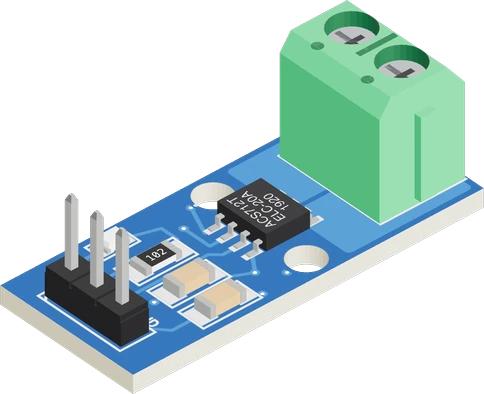
The ACS712 needs 4.5 V to 5.5 V, which the Arduino Uno's 5V pin provides, and its output stays within the Uno's 0 to 5 V analog range, so OUT goes straight to A0 with no divider. Because the Uno's ADC reference is that same 5 V, zero current reads 512 counts even when the USB voltage drifts.
Wiring the ACS712 Current Sensor (20A) to the Arduino Uno
Pin by pin.
| ACS712 Current Sensor (20A) | Arduino Uno |
|---|---|
| VCC | 5V |
| GND | GND |
| OUT | A0 |
What to know on the Arduino Uno
- The ACS712's output is ratiometric (VCC × 0.5 at zero current) and the Uno's analogRead() is referenced to the same 5 V supply, so a USB rail that sags shifts both together and zero amps still reads 512.Allegro ACS712 datasheet Rev. 22, pp. 5, 10; Microchip ATmega328P datasheet DS40002061B, p. 2
- The Uno's 10-bit ADC gives 5 V / 1024, about 4.9 mV per count. At 100 mV/A on the 20 A module, one count is about 49 mA; on the 5 A module (185 mV/A) it is about 26 mA. That is the Uno's floor, before noise.Microchip ATmega328P datasheet DS40002061B, p. 2; Allegro ACS712 datasheet Rev. 22, p. 2
- The 20 A chip shows about 11 mV peak to peak of noise, a little over two Uno ADC counts, so the code averages 64 readings for a steady value.Allegro ACS712 datasheet Rev. 22, p. 6
- The module draws 10 mA typical from the Uno's 5V pin; the measured current flows only through the screw terminal, never through the Uno.Allegro ACS712 datasheet Rev. 22, p. 5
ACS712 Current Sensor (20A) code for the Arduino Uno
Compiled for arduino:avr:uno on 2026-10-29.
// ACS712 Current Sensor (20A) on Arduino Uno: wiring and a free simulation at https://www.tinkered.ai/components/acs712-current-sensor/arduino-uno
#include <Arduino.h>

const int SENSE_PIN = A0;
const float SENS_V_PER_A = 0.100;   // 20 A module (0.185 for 5 A, 0.066 for 30 A)
const float VREF = 5.0;             // the Uno's ADC reference: its 5 V
const float ADC_MAX = 1024.0;       // 10 bits
const float ZERO_V = VREF / 2.0;    // OUT with no current: VCC / 2
const int SAMPLES = 64;

float readAmps() {
  long sum = 0;
  for (int i = 0; i < SAMPLES; i++) sum += analogRead(SENSE_PIN);
  float volts = (sum / (float)SAMPLES) * VREF / ADC_MAX;
  return (volts - ZERO_V) / SENS_V_PER_A;
}

void setup() {
  Serial.begin(115200);
  Serial.println("ACS712 ready");
}

void loop() {
  float amps = readAmps();
  Serial.print("Current: ");
  Serial.print(amps, 3);
  Serial.print(" A  (");
  Serial.print(amps * 1000.0, 0);
  Serial.println(" mA)");
  delay(500);
}
ACS712 Current Sensor (20A) on the Arduino Uno: questions
Do I need a voltage divider between the ACS712 and an Arduino Uno?
No. The Uno's analog inputs read 0 to 5 V, the same range as the ACS712's output on a 5 V supply. A divider is only needed on 3.3 V boards such as an ESP32 or a Pico.
What is the smallest current an Arduino Uno can measure with an ACS712 20A?
One Uno ADC step is about 4.9 mV (5 V over 1024 counts), which is about 49 mA at the 20 A module's 100 mV/A. Averaging helps with noise, but for currents of a few hundred milliamps the 5 A module (185 mV/A) or an external ADC resolves more.
Why does my ACS712 read 512 with no current on the Uno?
That is correct: the sensor outputs half its supply at zero current, and with the Uno's ADC referenced to the same 5 V, half scale is 512 counts. Subtract 512 before scaling to amps.
Keep going
This guide as plain Markdown. /components/acs712-current-sensor/arduino-uno.md