Speaker (3W, 4Ω)
A 3 W, 4 Ω speaker sealed in a small 70 mm enclosure, the natural partner for a MAX98357A or another class-D amplifier.
- Impedance4 Ω
- Power3 W or less
- Dimensions31 × 70 × 17 mm
- Mounting3.1 mm holes on a 31 × 64 mm rectangle
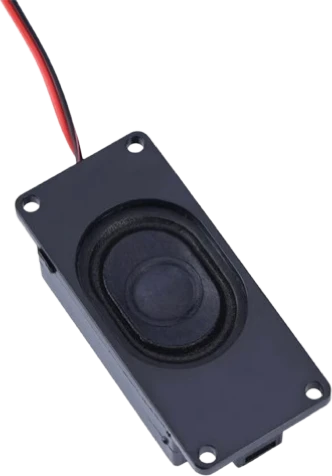
This is a mono 4 Ω speaker for 3 W or less, sealed in a 31 × 70 × 17 mm enclosure with 30 cm bare leads and 3.1 mm mounting holes (Adafruit product 4445). It must be driven by an amplifier, never a GPIO: clamp the red lead into the + terminal and the black into the - terminal of an amp such as the MAX98357A, which delivers up to 3.2 W into 4 Ω at 5 V (Maxim MAX98357A datasheet Rev 7, p. 5). The amp's output is bridge-tied, so neither lead goes to GND (Adafruit MAX98357 guide).
The enclosed 3 W, 4 Ω speaker is a small oval driver built into a closed plastic box. The enclosure keeps the sound from the back of the cone from cancelling the front, so it sounds fuller and louder than a bare speaker of the same size. Adafruit sells it as product 4445: 4 Ω impedance, for applications that need 3 W or less, 31 × 70 × 17 mm, 25 g, with 30 cm bare wires and 3.1 mm mounting holes on a 31 × 64 mm rectangle (Adafruit product 4445).
A loudspeaker is a low-impedance load. At 4 Ω, a 3.3 V or 5 V signal would try to push close to an ampere, far beyond what a microcontroller pin can deliver, so the speaker always sits behind an amplifier. Class-D amplifiers suit it well: Adafruit recommends its MAX98306, TS2012 and TPA2016 boards for this speaker (Adafruit product 4445), and the MAX98357A I2S amplifier produces 3.2 W into 4 Ω at 5 V and 10 % THD+N, or 2.5 W at 1 % (Maxim MAX98357A datasheet Rev 7, p. 5), which matches the speaker's 3 W rating.
The leads are bare and stripped, ready for a screw terminal. Red is +, black is -. With a single speaker, polarity only matters for phase; with two speakers in a stereo pair, keep both the same way round so they push air together. Mount it with M3 screws through its four holes, with the grille facing an opening in the case.
How to wire the Speaker (3W, 4Ω)
| POS | MAX98357A I2S 3W Amplifier OUTP | Speaker + |
|---|---|---|
| NEG | MAX98357A I2S 3W Amplifier OUTN | Speaker - (never to GND) |
Before you wire it
- A loudspeaker (4 ohm voice coil, 3 W) needs an amplifier. Wire it to the output terminal of an I2S amp (max98357a-i2s-amp): red lead (POS) to OUTP (+), black lead (NEG) to OUTN (-).
- Never wire it to an MCU pin (a GPIO cannot drive 4 ohm: it would be damaged) or between a pin and GND.
- Never wire one lead to GND: the MAX98357A's output is bridge-tied, both terminals are driven.
- For simple beeps on any board, a piezo buzzer with tone() needs no amplifier.
- Always drive it from an amplifier. Red lead (+) to the amp's + output, black lead (-) to its - output.
- With a bridge-tied amplifier such as the MAX98357A, both outputs are driven: neither speaker lead may touch GND or a supply (Adafruit MAX98357 guide).
- One speaker per amplifier channel. Two 4 Ω speakers in parallel present 2 Ω, below the 4 Ω minimum Adafruit specifies for its MAX98357 board.
- Power the amplifier from 5 V for the most volume: the MAX98357A gives 3.2 W into 4 Ω at 5 V (datasheet, p. 5) against 1.3 W at 3.3 V (Adafruit guide). Adafruit asks for at least 800 mA of supply for that amp at 5 V.
- For simple beeps with no amplifier, use a piezo buzzer and tone() instead.
- Drive it from an amplifier rated for a 4 Ω or higher load.
Specifications
- Impedance
- 4 ΩAdafruit product 4445
- Power
- 3 W or lessAdafruit product 4445
- Dimensions
- 31 × 70 × 17 mmAdafruit product 4445
- Mounting
- 3.1 mm holes on a 31 × 64 mm rectangleAdafruit product 4445
- Leads
- 30 cm, bare wires, no connectorAdafruit product 4445
- Weight
- 25 gAdafruit product 4445
- MAX98357A output into 4 Ω at 5 V
- 3.2 W at 10 % THD+N, 2.5 W at 1 % THD+NMaxim MAX98357A datasheet Rev 7, p. 5
- MAX98357A output into 4 Ω at 3.3 V
- 1.3 W max at 10 % THDAdafruit MAX98357 I2S Class-D Mono Amp guide, Pinouts
From the Adafruit 4445 (generic 70x30mm enclosed speaker)'s datasheet, published by Adafruit 4445 (generic 70x30mm enclosed speaker).
Common mistakes
Wiring the speaker to a GPIO pin
A 4 Ω speaker on a pin draws far more current than the pin can give and can damage it. Put an amplifier in between.
Connecting one lead to GND on a bridge-tied amp
Class-D amps such as the MAX98357A drive both terminals (Adafruit MAX98357 guide). Grounding one shorts an output; the amp cuts out or distorts.
Overdriving it
The speaker is rated for 3 W or less (Adafruit product 4445). A larger amplifier turned up full can push it into distortion or damage it; keep the amplifier's gain and the source volume moderate.
Two speakers on one mono amp
Two 4 Ω speakers in parallel are 2 Ω, which overloads an amp rated for 4 Ω or more. Use one amplifier per speaker, or a stereo amp.
Speaker (3W, 4Ω) questions
Can I connect a 4 Ω speaker directly to an Arduino or ESP32 pin?
No. A 4 Ω load would draw close to an ampere from a 3.3 V or 5 V pin, far more than any GPIO supplies. Use an amplifier such as the MAX98357A, which drives 4 Ω at up to 3.2 W from 5 V (MAX98357A datasheet, p. 5).
What amplifier should I use with a 3 W, 4 Ω speaker?
On an ESP32, ESP8266 or Raspberry Pi Pico, the MAX98357A I2S amplifier, which delivers 3.2 W into 4 Ω at 5 V (datasheet, p. 5). For analog sources, Adafruit suggests class-D boards such as the MAX98306, TS2012 or TPA2016 for this speaker (Adafruit product 4445).
Is 3.3 V enough to drive this speaker?
Yes, but more quietly. A MAX98357A powered from 3.3 V gives up to 1.3 W into 4 Ω at 10 % THD (Adafruit MAX98357 guide), against 3.2 W at 5 V (datasheet, p. 5). Power the amplifier from 5 V when you want volume; its I2S inputs still accept 3.3 V logic.
Why does my speaker crackle or distort?
Usual causes are a weak supply sagging on loud passages (Adafruit asks for at least 800 mA at 5 V for the MAX98357A), gain set too high for the audio level, a lead touching GND on a bridge-tied amp, or a loose lead in the screw terminal.
Does speaker polarity matter?
For one speaker it changes nothing you can hear. For two speakers playing together, wire both red leads to + so their cones move in phase; reversed, the bass partly cancels.
How big is the enclosed 3 W speaker and how do I mount it?
It measures 31 × 70 × 17 mm and weighs 25 g, with 3.1 mm mounting holes on a 31 × 64 mm rectangle (Adafruit product 4445). M3 screws fit; face the grille toward an opening in the case.
Build something with the Speaker (3W, 4Ω)
- Build this
ESP32 internet radio
Stream audio over Wi-Fi and play it through a MAX98357A and this speaker.
- Build this
Talking voice assistant
Give an ESP32-S3 project a voice with text-to-speech output.
- Build this
Sound effects box
Play WAV clips from a microSD card when buttons or sensors trigger them.
- Build this
Custom doorbell
Play any chime you like when the button is pressed.
This page as plain Markdown, for ChatGPT, Claude or your own agent. /components/speaker-enclosed-3w-4ohm.md