1kΩ Resistor
A 1 kΩ, 1/4 W axial carbon film resistor for current limiting, pull-ups, pull-downs, and voltage dividers.

What is the 1kΩ Resistor?
The 1 kΩ resistor is a fixed, two-terminal passive that opposes current flow by a defined amount of 1000 ohms. Its dimensions (about 6.3 mm body length and 2.4 to 2.5 mm diameter) match a standard 1/4 W axial through-hole carbon film part, such as the Yageo CFR-25 class. It is non-polarized, so it behaves identically no matter which lead faces which node.
Electrically it follows Ohm's law (V = I x R). For the 1/4 W (0.25 W) rating, the safe dissipation limit is 250 mW at 70 C, derating linearly to zero at 155 C. The standard 1 kΩ value comes in the E24 series with ±5% (J) or ±2% (G) tolerance, and its four-band color code is brown, black, red, followed by the tolerance band. Maximum working voltage for the CFR-25 size is 250 V.
1 kΩ is one of the most common values in hobby electronics: a base resistor for small BJTs like the 2N2222, a strong pull-up or pull-down on logic lines and buttons, one leg of a voltage divider, and a conservative LED series resistor. Rated over -55 C to +155 C, it suits nearly all general-purpose signal-level work.
Specifications
- Dimensions
- 6.3 × 2.5 × 2.5 mm
Verified from the Tinkered component library.
Circuit requirements
- Non-polarized: either lead can connect to either node, so orientation never matters for wiring. The color-band direction only matters when reading the value, not when placing the part.
- Sizing by Ohm's law: at 5 V across 1 kΩ the current is 5 mA and the dissipated power is 0.025 W, well within the 1/4 W limit.
- As an LED current-limiter on 5 V with a ~2 V LED, 1 kΩ passes only about 3 mA ((5 - 2) / 1000), giving a dim but safe LED. For normal indicator brightness use roughly 220-330Ω instead.
- As a base resistor for a small NPN BJT driven from a 5 V logic pin, 1 kΩ delivers roughly 4 mA of base drive ((5 - 0.7) / 1000), enough to saturate a 2N2222 switching typical loads.
- As a pull-up or pull-down, 1 kΩ is a strong (low-impedance) pull that draws about 5 mA at 5 V when the pin is driven to the opposite rail; for typical MCU inputs 4.7k-10k is more common and lighter on current.
- Respect the power rating: at 1 kΩ, dissipation reaches 1/4 W near 16 V continuous (V^2 / R). Above that use a higher-wattage resistor, and derate above 70 C ambient.
Common 1kΩ Resistor mistakes
Misreading the color bands
1 kΩ is brown-black-red. Brown-black-orange is 10 kΩ, and reading the resistor from the tolerance-band end flips the value. Confirm with a meter when unsure.
Expecting a bright LED from a 1 kΩ limiter
On a 5 V rail a 1 kΩ resistor only lets a few milliamps reach an LED, so it glows dimly. Use around 220-330Ω for typical brightness and keep 1 kΩ for a deliberately faint indicator.
Treating ±5% tolerance as exact
A nominal 1 kΩ part can measure anywhere from about 950 to 1050Ω. That spread matters in voltage dividers and precision analog; use a ±1% metal film resistor where accuracy counts.
Ignoring the 1/4 W power limit
Above roughly 16 V continuously across 1 kΩ the resistor exceeds 0.25 W and overheats. For higher voltages or currents, choose a 1/2 W or larger part and derate above 70 C.
Using 1 kΩ where a weak pull-up is intended
A 1 kΩ pull-up sinks about 5 mA when the line is pulled low, which can overload weak drivers or waste current on battery projects. Reach for 4.7k-10k unless you specifically need the stronger, noise-resistant pull.
More passives & discretes

resistor-220220Ω Resistor
Custom resistance values supported

resistor-10k10kΩ Resistor
Custom resistance values supported
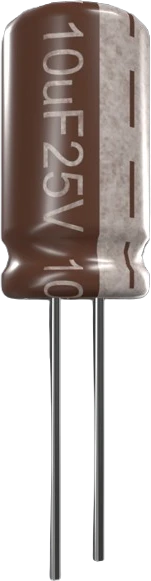
capacitor-ceramic100nF Ceramic Capacitor
Custom capacitance values supported
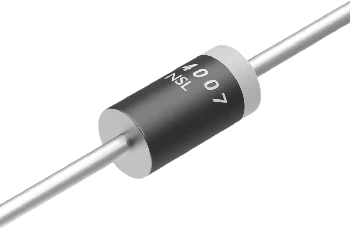
diode-1n40071N4007 Diode
General-purpose rectifier
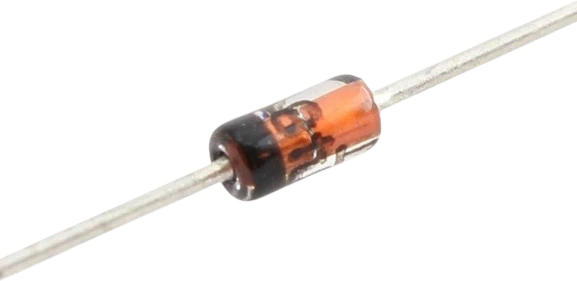
diode-1n41481N4148 Diode
Fast switching diode
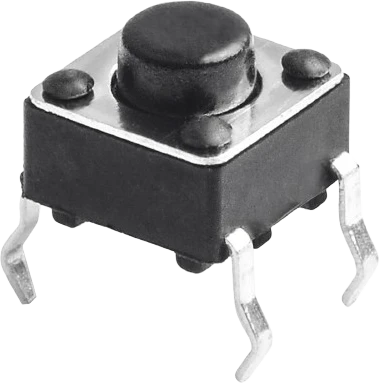
push-buttonPush Button
Momentary digital input
Build with the 1kΩ Resistor.
Drop the 1kΩ Resistor into a circuit, write firmware, and simulate it in your browser, then deploy to real hardware. All in one editable Tinkered project.