Guitar overdrive and distortion pedals
A pair of 1N4148s in the op-amp feedback path (as in Tube Screamer-style circuits) soft-clips the audio signal to create classic overdrive tones, making it a staple of DIY pedal builds.
A small-signal fast switching diode in a DO-35 glass package, with roughly 0.7 V forward drop and a reverse recovery time near 4 ns.
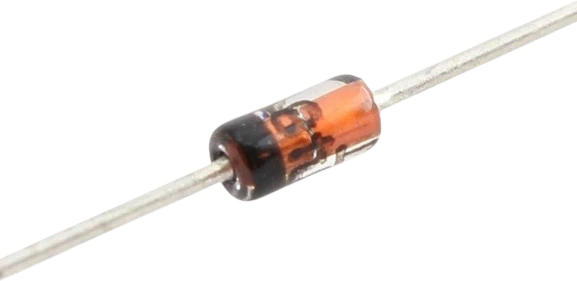
The 1N4148 is one of the most widely used general-purpose small-signal diodes in electronics. It ships in a tiny axial DO-35 glass package and is rated for up to 100 V repetitive peak reverse voltage with about 200 mA of continuous forward current. It is a signal-level part for switching, steering, and protection, not a power rectifier.
Its defining feature is speed. A reverse recovery time of roughly 4 ns lets it switch cleanly in high-frequency and logic circuits where slower rectifiers like the 1N4007 would fail. When forward biased it conducts at a typical drop of about 0.7 V, and when reverse biased it blocks up to its rated voltage while leaking only a tiny reverse current.
Typical jobs include flyback (freewheeling) protection across relays and other inductive loads, signal clamping to hold a node within a voltage range, diode logic (OR and AND steering), and waveform clipping. The cathode is marked with a band printed on the body, which sets the direction current is allowed to flow.
Verified from the Tinkered component library.
The band marks the cathode, not the anode. A reversed diode blocks the current you wanted to pass, or removes the protection you intended. Check the band against your schematic before soldering.
The 1N4148 is a small-signal part rated for about 200 mA and 100 V. Using it on a mains supply, a motor, or any high-current load will overheat and destroy it. Reach for a 1N4007 or a proper power diode there.
The 1N4148 is fast (about 4 ns recovery) but low current; the 1N4007 is slow but handles 1 A and 1000 V. They are not interchangeable. Match the part to whether you need speed or current handling.
The roughly 0.7 V drop is significant in low-voltage logic, clamping, and precision analog circuits. Forgetting it shifts thresholds and can leave a clamped node about 0.7 V above or below the rail you expected.
Applying more than the 100 V rated peak reverse voltage can break the diode down destructively. In flyback and clamping circuits, confirm the worst-case reverse voltage stays within spec.
A pair of 1N4148s in the op-amp feedback path (as in Tube Screamer-style circuits) soft-clips the audio signal to create classic overdrive tones, making it a staple of DIY pedal builds.
Placed across a relay coil driven by a transistor or microcontroller pin, the 1N4148 clamps the inductive voltage spike when the coil switches off, protecting the driving device.

resistor-220Custom resistance values supported

resistor-1kCustom resistance values supported

resistor-10kCustom resistance values supported
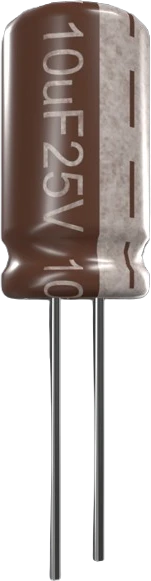
capacitor-ceramicCustom capacitance values supported
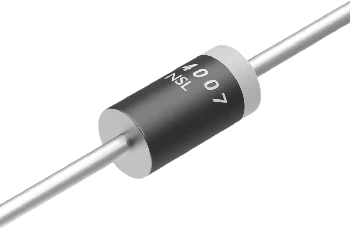
diode-1n4007General-purpose rectifier
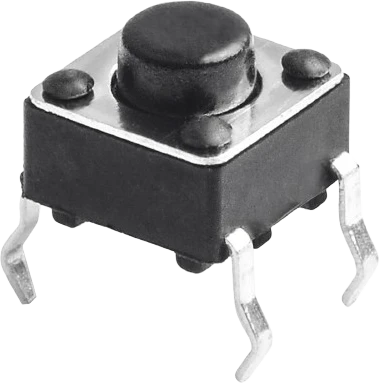
push-buttonMomentary digital input
Drop the 1N4148 Diode into a circuit, write firmware, and simulate it in your browser, then deploy to real hardware. All in one editable Tinkered project.