18650 Li-ion Cell + Holder
A rechargeable cylindrical lithium-ion cell, 18 mm by 65 mm, that charges to 4.2 V and powers projects from about 3.6 V nominal.
- Nominal voltage (LG INR18650 MJ1)3.635 V average
- Maximum charge voltage4.2 V ±0.05 V
- Discharge cutoff2.5 V
- Charge methodConstant current then constant voltage (CC/CV); standard 0.5 C to 4.2 V, ending at 50 mA
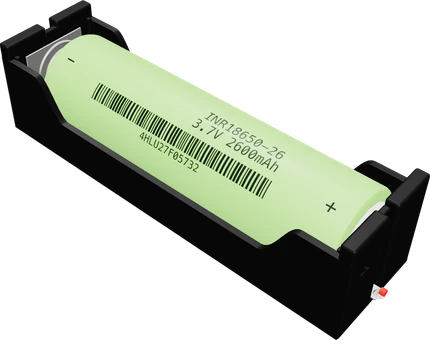
An 18650 is a rechargeable lithium-ion cell about 18 mm wide and 65 mm long that sits near 3.6 V, charges to 4.2 V and is empty at 2.5 V; LG's INR18650 MJ1, for example, is rated 3.635 V nominal, 4.2 ±0.05 V maximum charge and 2.5 V discharge cutoff (LG MJ1 specification, p. 4). Charge it with a single-cell Li-ion charger such as a TP4056 module and power your project from the module's protected OUT pads. Its 2.5 V to 4.2 V swing fits a Raspberry Pi Pico's VSYS directly, while a 5 V board needs a boost converter and a 3.3 V board a low-dropout regulator.
The 18650 is the most common rechargeable lithium-ion cell in maker projects, laptop packs, flashlights and power banks. Its name is its size: 18 mm in diameter and 65 mm long. LG's INR18650 MJ1, a typical unprotected cell, measures 18.4 mm (18.5 mm max) by 65.0 mm (65.2 mm max) and weighs at most 49 g (LG MJ1 specification, pp. 4, 5). This part is one cell in an open holder with a red lead on + and a black lead on -.
A lithium-ion cell has a narrow working window. The MJ1 averages 3.635 V over a discharge, charges by constant current then constant voltage to 4.2 ±0.05 V, and is specified down to a 2.5 V discharge cutoff (p. 4). It may be charged only between 0 °C and 45 °C and discharged between -20 °C and 60 °C (pp. 4, 8). Capacity and current depend on the exact cell: the MJ1 is rated 3500 mAh nominal and 3400 mAh minimum, with up to 3400 mA of charge current and 10 A of discharge current (p. 4). Read the datasheet of the cell you actually buy.
Cells come in two kinds. An unprotected cell, like the MJ1, is the bare cell; LG asks that a protection circuit be installed in the pack or charger to stop over-charge, over-discharge and over-current (p. 9). A protected cell carries a small protection board under its wrapper, which makes it slightly longer and can keep it from fitting a tight holder. With an unprotected cell in an open holder, the protection comes from the circuit around it, for example the DW01A on a protected TP4056 module, which disconnects the load below 2.40 V (DW01x datasheet, p. 8).
Before you wire it
- A pack that powers motors or servos while a board drives their signals shares its GND with the board (black lead and board GND on the same rail).
- No 4xAA on a Pico's VSYS, a 3V3 pin or a board's 5V pin.
- No 18650 on any 3V3 pin, nor straight on an ESP32 DevKit's VIN (boost it to 5 V first).
- No reversed leads: red is always +.
- Charge only with a single-cell Li-ion charger that ends at 4.2 V. A TP4056 module charges by constant current then constant voltage to 4.2 V ±1.5 % (TP4056 datasheet, p. 1), the same method LG specifies for its cells (LG MJ1 specification, p. 9). At its usual 1.2 kΩ setting it charges at 1000 mA (TP4056 datasheet, p. 3), below the MJ1's 0.5 C standard charge of 1700 mA (LG MJ1 specification, p. 4).
- Power the project through protection. An unprotected cell needs a circuit that cuts it off: LG asks for one in the pack or charger (LG MJ1 specification, p. 9). The OUT pads of a protected TP4056 module pass through a DW01A that disconnects below 2.40 V, above 4.30 V and on overcurrent (DW01x datasheet, p. 8).
- A Raspberry Pi Pico takes the cell straight on VSYS, which accepts 1.8 V to 5.5 V (Raspberry Pi Pico datasheet, p. 8).
- A 5 V board (an Arduino UNO, an ESP32 DevKit's VIN, 5 V sensors and servos) needs a boost converter such as an MT3608 module set to 5 V after the protection. The cell alone is too low: an ESP32 DevKit's AMS1117 regulator needs about 1.1 V more than its 3.3 V output (AMS1117 datasheet, p. 3).
- A 3.3 V part must never see the cell directly: a full cell is 4.2 V (LG MJ1 specification, p. 4). Use a 3.3 V regulator with a dropout low enough for a cell near 3.6 V, or a buck-boost converter that holds 3.3 V across the whole 2.5 V to 4.2 V range.
- Never connect + and - with metal or wire, and do not solder to the cell directly (LG MJ1 specification, p. 8). An 18650 can deliver many amperes into a short. Use a holder, and add a fuse when the wiring is long or exposed.
- For the cited LG MJ1 cell: empty at 2.5 V, 10 A maximum discharge.
Specifications
- Nominal voltage (LG INR18650 MJ1)
- 3.635 V averageLG INR18650 MJ1 product specification, Rev. 1, p. 4
- Maximum charge voltage
- 4.2 V ±0.05 VLG INR18650 MJ1 product specification, Rev. 1, p. 4
- Discharge cutoff
- 2.5 VLG INR18650 MJ1 product specification, Rev. 1, p. 4
- Charge method
- Constant current then constant voltage (CC/CV); standard 0.5 C to 4.2 V, ending at 50 mALG INR18650 MJ1 product specification, Rev. 1, p. 4
- Charge temperature
- 0 °C to 45 °CLG INR18650 MJ1 product specification, Rev. 1, pp. 4, 8
- Discharge temperature
- -20 °C to 60 °CLG INR18650 MJ1 product specification, Rev. 1, p. 4
- Capacity (MJ1 only)
- 3500 mAh nominal, 3400 mAh minimumLG INR18650 MJ1 product specification, Rev. 1, p. 4
- Maximum currents (MJ1 only)
- Charge 1.0 C (3400 mA); discharge 10 ALG INR18650 MJ1 product specification, Rev. 1, p. 4
- Size (MJ1)
- 18.4 mm diameter (18.5 max), 65.0 mm long (65.2 max), 49 g maxLG INR18650 MJ1 product specification, Rev. 1, pp. 4, 5
- Holder leads
- Red = + (VCC), black = - (GND), 150 mmTinkered registry
- Supply voltage
- 3.7 V
- Dimensions
- 77 × 21 × 20 mm
- Weight
- 54 g
Common mistakes
Shorting the cell
A loose lead, a tool across the holder or a wire brushing a breadboard rail can short the cell. LG forbids connecting + and - with any conductive material (LG MJ1 specification, p. 8); an unprotected cell will push a very high current into the short and heat fast. Insulate the leads and keep the holder away from bare metal.
Charging below 0 °C
LG allows charging only between 0 °C and 45 °C (LG MJ1 specification, pp. 4, 8). Charging a frozen cell damages it. A TP4056 module with its TEMP pin grounded does not check temperature (TP4056 datasheet, p. 2), so a project left outdoors in winter must stop charging itself.
Wiring the cell straight to a 3V3 or 5V pin
A full cell is 4.2 V (LG MJ1 specification, p. 4): too high for a 3V3 pin and too low for a 5 V rail. Regulate it down to 3.3 V or boost it up to 5 V, or use a board with a wide input such as a Pico's VSYS.
Draining an unprotected cell flat
Below its 2.5 V cutoff (LG MJ1 specification, p. 4) a lithium-ion cell is over-discharged and can be damaged. Power the project from a protected output, such as a TP4056 module's OUT pads, which cut off at 2.40 V (DW01x datasheet, p. 8).
Charging with the wrong charger
NiMH, lead-acid and LiFePO4 chargers use different voltages and methods. An 18650 takes CC/CV charging to 4.2 V at no more than its rated current (LG MJ1 specification, pp. 4, 9). Use a single-cell Li-ion charger such as the TP4056.
18650 Li-ion Cell + Holder questions
What voltage is an 18650 battery?
About 3.6 V to 3.7 V nominal, 4.2 V full and 2.5 V empty. LG's INR18650 MJ1, for example, is rated 3.635 V nominal, 4.2 ±0.05 V maximum charge and a 2.5 V discharge cutoff (LG MJ1 specification, p. 4). Plan any circuit for the whole 2.5 V to 4.2 V range.
Can I power an ESP32 or Arduino from one 18650?
Not directly. The cell's 2.5 V to 4.2 V (LG MJ1 specification, p. 4) is too low for a 5 V input and an ESP32 DevKit's AMS1117, which needs about 1.1 V of headroom above 3.3 V (AMS1117 datasheet, p. 3). Charge and protect the cell with a TP4056 module and boost its OUT to 5 V with an MT3608 into VIN or 5V. A Raspberry Pi Pico is the exception: its VSYS takes 1.8 V to 5.5 V (Raspberry Pi Pico datasheet, p. 8).
Can I charge an 18650 with a TP4056?
Yes. The TP4056 charges a single Li-ion cell by constant current then constant voltage to 4.2 V (TP4056 datasheet, p. 1), the method LG specifies (LG MJ1 specification, p. 9). At 1000 mA, the common module setting (TP4056 datasheet, p. 3), it stays below the MJ1's standard 0.5 C charge of 1700 mA (LG MJ1 specification, p. 4).
Protected or unprotected 18650: which should I buy?
A protected cell carries its own small circuit that cuts it off on over-charge, over-discharge and short circuit; it is slightly longer and may not fit every holder. An unprotected cell needs that protection elsewhere, as LG asks (LG MJ1 specification, p. 9). In an open holder, either works if the project draws through a protected charger output such as a TP4056 module's OUT pads (DW01x datasheet, p. 8).
Why won't my project run from the 18650 even though it shows 3.7 V?
Check what the cell feeds. A 3.3 V regulator with a large dropout, like the AMS1117 at about 1.1 V (AMS1117 datasheet, p. 3), cannot make 3.3 V from 3.7 V, and a 5 V board's VIN needs more than the cell gives. Also check that a protected output has not cut off: a DW01A stays off until the cell recovers to 3.00 V (DW01x datasheet, p. 8), which needs a charge.
Can I charge an 18650 in the cold?
No. LG allows charging only from 0 °C to 45 °C, although the cell may discharge from -20 °C to 60 °C (LG MJ1 specification, pp. 4, 8). An outdoor project should stop charging below 0 °C.
How many mAh is an 18650?
It depends on the cell, not the size. LG's INR18650 MJ1 is rated 3500 mAh nominal and 3400 mAh minimum (LG MJ1 specification, p. 4); other models trade capacity for current. Check the datasheet of the cell you buy.
Build something with the 18650 Li-ion Cell + Holder
Portable ESP32 weather station
An 18650, a TP4056 and an MT3608 at 5 V run an ESP32 and its sensors off-grid and recharge over USB.
Raspberry Pi Pico handheld
Wire the cell's protected output straight to VSYS for a small game, logger or remote control.
Solar-charged sensor node
A small panel feeds the charger by day; the cell carries a low-power board through the night.
DIY USB power bank
A charger, a protected cell and a 5 V boost module make a pocket power bank.
Battery-powered robot
One or more cells drive a small rover's controller and motors through a boost or buck stage.
This page as plain Markdown, for ChatGPT, Claude or your own agent. /components/battery-18650.md