2 x AA Battery Holder
An open holder with two AA alkaline cells in series that supplies a nominal 3 V for LEDs, 3 V logic and a Pico's VSYS.
- Pack voltage3 V nominal (2 × 1.5 V in series)
- Cell chemistry (E91)Alkaline, zinc-manganese dioxide (Zn/MnO2), ANSI-15A / IEC-LR6
- End-of-life point used by Energizer0.8 V per cell (1.6 V for the pack)
- Internal resistance per cell150 to 300 mΩ fresh
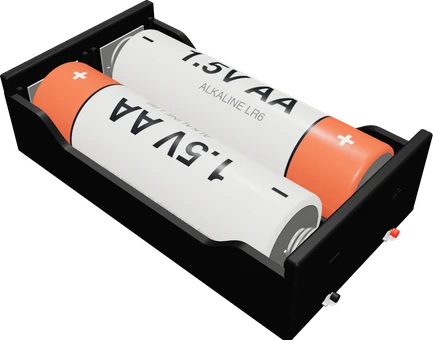
A 2 x AA holder puts two 1.5 V alkaline cells in series for a nominal 3 V (Energizer E91 datasheet, p. 1), on a red + lead and a black - lead. It runs LEDs, 3 V logic and a Raspberry Pi Pico through VSYS, which accepts 1.8 V to 5.5 V (Raspberry Pi Pico datasheet, p. 8), but it is too low for a 5 V Arduino's 5V or VIN pin. Energizer rates its cells to 0.8 V each at end of life, so the pack falls from 3 V toward 1.6 V as it drains (E91 datasheet, p. 1).
The 2 x AA battery holder is the simplest way to run a small circuit away from USB. Two AA cells sit in series in an open plastic holder, and two leads bring the pack out: red for + and black for -. With alkaline cells such as the Energizer E91, each rated 1.5 V nominal (Energizer E91 datasheet, p. 1), the pack supplies 3 V nominal.
An alkaline cell's voltage falls steadily as it discharges. Energizer rates the E91's service time down to a 0.8 V end point, and its internal resistance is 150 to 300 mΩ when fresh (E91 datasheet, p. 1). So a 2 x AA pack sags with both age and load: the heavier the current, the sooner a circuit with a minimum voltage stops. The cells work from -18 °C to 55 °C and keep for 10 years at 21 °C on the shelf (p. 1).
Three volts suits loads that need no regulation: LEDs with a resistor, 3 V logic, and boards with a wide input. A Raspberry Pi Pico's VSYS accepts 1.8 V to 5.5 V and feeds an on-board buck-boost converter (Raspberry Pi Pico datasheet, p. 8), so it keeps running as the cells drain. A 5 V Arduino needs more: power it from USB, a 9 V source on VIN, or a boost converter.
Before you wire it
- A pack that powers motors or servos while a board drives their signals shares its GND with the board (black lead and board GND on the same rail).
- No 4xAA on a Pico's VSYS, a 3V3 pin or a board's 5V pin.
- No 18650 on any 3V3 pin, nor straight on an ESP32 DevKit's VIN (boost it to 5 V first).
- No reversed leads: red is always +.
- Red is +, black is -. Connect black to the circuit's ground and red to the supply input, never the other way round.
- A Raspberry Pi Pico takes the pack on VSYS, rated 1.8 V to 5.5 V (Raspberry Pi Pico datasheet, p. 8); the board's buck-boost converter makes its 3.3 V from it. Do not wire the pack to a 3V3 pin of a board that has its own regulator; feed its supply input instead.
- A 5 V Arduino UNO or Nano cannot run from this pack: their VIN pins expect a higher voltage for the on-board regulator, and 3 V on the 5V pin is below what a 5 V board needs. Use USB, a 9 V source on VIN, or a boost converter.
- LEDs still need a series resistor. Size it for a fresh pack, so the LED never sees too much current.
- When the pack powers motors or servos and a board drives their signals, connect the pack's black lead to the board's GND.
- The pack's voltage drops under load and as the cells drain, down to the 0.8 V per cell Energizer uses as end of life (E91 datasheet, p. 1). Choose loads that tolerate the range, or regulate.
- Energizer's E91 sheet rates the AA cell down to 0.8 V and gives no maximum current.
2 x AA Battery Holder variants
The same part in the values and versions the studio carries.
| Variant | Holds | Voltage | Size |
|---|---|---|---|
| 2 x AA Battery Holder | 2 × AA | 3 V | 59.5 × 32.9 × 16 mm |
| 4 x AA Battery Holder | 4 × AA | 6 V | 58 × 63 × 16 mm |
| 2 x AAA Battery Holder | 2 × AAA | 3 V | 53 × 24.6 × 13 mm |
Specifications
- Pack voltage
- 3 V nominal (2 × 1.5 V in series)Energizer E91 datasheet, p. 1
- Cell chemistry (E91)
- Alkaline, zinc-manganese dioxide (Zn/MnO2), ANSI-15A / IEC-LR6Energizer E91 datasheet, p. 1
- End-of-life point used by Energizer
- 0.8 V per cell (1.6 V for the pack)Energizer E91 datasheet, p. 1
- Internal resistance per cell
- 150 to 300 mΩ freshEnergizer E91 datasheet, p. 1
- Operating temperature
- -18 °C to 55 °CEnergizer E91 datasheet, p. 1
- Shelf life
- 10 years at 21 °CEnergizer E91 datasheet, p. 1
- Cell size
- 50.5 mm long max, 14.5 mm diameter max; 23.0 g typicalEnergizer E91 datasheet, p. 1
- Holder size
- 59.5 × 32.9 × 16 mm, 150 mm leadsTinkered registry
- Leads
- Red = + (VCC), black = - (GND)Tinkered registry
- Supply voltage
- 3 V
- Dimensions
- 59.5 × 32.9 × 16 mm
- Weight
- 54 g
Common mistakes
Expecting it to run a 5 V Arduino
Two alkaline cells make 3 V nominal (Energizer E91 datasheet, p. 1). That is below what an UNO's VIN regulator or 5V pin needs, so the board resets or does nothing. Use USB, a 9 V source or a boost converter.
Reversing the leads
Red is + and black is -. Reversed, the pack pushes current backwards through the board's input and can damage it. Check polarity before connecting.
Driving motors or servos from AAs and the logic from the same weak pack
Alkaline cells have 150 to 300 mΩ of internal resistance each when fresh (E91 datasheet, p. 1), so a motor's inrush pulls the pack voltage down and resets a board on the same supply. Give motors their own supply, and share only the ground.
Mixing old and new cells
In series, a weaker cell is driven harder by the fresher one and can leak. Replace both cells together, with the same type and brand.
Charging alkaline cells
The E91 is a primary alkaline cell (E91 datasheet, p. 1), not a rechargeable one. Never put it on a charger, a TP4056 included, which is for a single Li-ion cell only.
2 x AA Battery Holder questions
What voltage does a 2 x AA battery pack give?
3 V nominal: two 1.5 V alkaline cells in series (Energizer E91 datasheet, p. 1). The pack falls as the cells drain, toward the 0.8 V per cell, 1.6 V for the pack, that Energizer uses as end of life (p. 1).
Can I power a Raspberry Pi Pico with two AA batteries?
Yes. Connect red to VSYS and black to GND. VSYS accepts 1.8 V to 5.5 V and feeds the Pico's buck-boost converter (Raspberry Pi Pico datasheet, p. 8), so the board keeps its 3.3 V rail as the cells drain.
Can two AA batteries power an Arduino UNO or an ESP32?
Not well. 3 V (Energizer E91 datasheet, p. 1) is below what an UNO's VIN or 5V pin needs, and an ESP32 DevKit's VIN feeds an AMS1117 that needs about 1.1 V above its 3.3 V output (AMS1117 datasheet, p. 3). Use USB, a higher-voltage pack or a boost converter for those boards.
Why does my circuit stop working while the batteries still show voltage?
Alkaline cells sag under load: each has 150 to 300 mΩ of internal resistance when fresh, and more as it drains (Energizer E91 datasheet, p. 1). A motor or a radio burst can pull the pack below what the board needs even when a meter with no load reads close to 3 V. Fresh cells, a separate motor supply or a board with a wide input such as a Pico's VSYS help.
2 x AA vs one 18650: which should I use?
Two AAs give 3 V nominal (Energizer E91 datasheet, p. 1), are sold everywhere and need no charger. An 18650 gives 3.6 V nominal and 4.2 V full, is rechargeable and delivers far more current, LG's INR18650 MJ1 up to 10 A (LG MJ1 specification, p. 4), but needs a Li-ion charger and protection. Both run a Pico's VSYS.
Can I use rechargeable AA cells in the holder?
Yes, NiMH AAs fit the same holder, but each runs at a lower voltage than an alkaline cell, so the pack gives less than 3 V. A Pico's VSYS still accepts it down to 1.8 V (Raspberry Pi Pico datasheet, p. 8); check the minimum input of anything else on the pack.
Build something with the 2 x AA Battery Holder
Battery-powered Pico project
Run a Raspberry Pi Pico logger, game or remote from two AAs on VSYS.
LED throwie or night light
Light an LED through a resistor straight from the pack, no board needed.
Low-power 3 V sensor
Power a 3 V sensor and a microcontroller in deep sleep for weeks of readings.
Portable buzzer or alarm
Drive a 3 V buzzer from a switch or a tilt sensor for a simple alarm.
This page as plain Markdown, for ChatGPT, Claude or your own agent. /components/battery-2xaa.md