HTU21D
A TE Connectivity (MEAS) HTU21D-F breakout that reads relative humidity and temperature over I2C at the fixed address 0x40.
- Chip supply1.5 V to 3.6 V (3.0 V typical)
- Absolute maximumVDD -0.3 V to 3.6 V; DATA and SCK at most VDD + 0.3 V
- I2C address0x40, fixed
- Humidity±2 %RH typical; 0.04 %RH at 12-bit; 5 s response (63 %, 33 to 75 %RH)
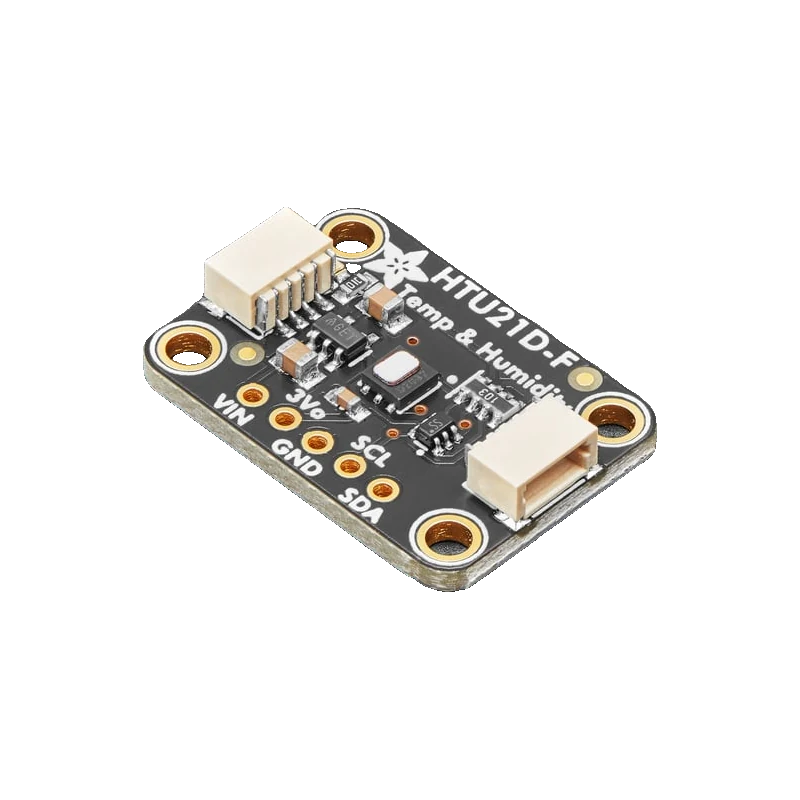
The HTU21D(F) is a digital humidity and temperature sensor with ±2 %RH and ±0.3 °C typical accuracy, 12-bit humidity and 14-bit temperature, running from 1.5 V to 3.6 V (MEAS HTU21D(F) datasheet, pp. 3, 5). It answers at fixed I2C address 0x40 (p. 10). The Adafruit HTU21D-F breakout adds a 3.3 V regulator and I2C level shifting, so VIN takes 3 V to 5 V.
The HTU21D(F) is a calibrated humidity and temperature sensor in a small DFN package; the F version carries a PTFE filter that keeps dust and water off the sensing element. It reads humidity with 0.04 %RH resolution at 12 bits and ±2 %RH typical accuracy, and temperature from -40 to +125 °C with 0.01 °C resolution at 14 bits and ±0.3 °C typical at 25 °C (MEAS datasheet, pp. 3, 5).
A 12-bit humidity reading takes 16 ms at most and a 14-bit temperature reading 50 ms (pp. 3, 5). Between readings it sleeps at 0.02 µA, and draws about 450 µA while measuring (p. 3). A small 5.5 mW heater can check that the sensor responds (p. 3).
The chip is a 3.6 V part (1.5 V to 3.6 V supply, 3.6 V absolute maximum, pp. 2 to 3). Adafruit's breakout adds a regulator and level shifting for 5 V boards (Adafruit guide, pp. 4, 7). The address 0x40 is fixed (guide, p. 6), and it collides with common parts such as the INA219 and PCA9685.
HTU21D pinout
| Pin | Function | Type |
|---|---|---|
| VIN | Vin3 V to 5 V | power in |
| 3Vo | 3Vo3.3 V | power out |
| GND | GND | power in |
| SCL | I2C SCLLevel shifted | input |
| SDA | I2C SDALevel shifted | bidirectional |
How to wire the HTU21D
Pin by pin, for the board you have.
| HTU21D | Arduino Uno | Note |
|---|---|---|
| VIN | 5V | |
| GND | GND | |
| SCL | A5 | |
| SDA | A4 |
- This assumes a breakout with a regulator and level shifter (such as the Adafruit HTU21D-F). A bare HTU21D is a 3.6 V part (datasheet, p. 2).
| HTU21D | ESP32 DevKit V1 | Note |
|---|---|---|
| VIN | 3V3 | |
| GND | GND | |
| SCL | GPIO22 (D22) | |
| SDA | GPIO21 (D21) |
- Power VIN from 3V3 so the I2C lines sit at 3.3 V on any HTU21D board.
| HTU21D | Raspberry Pi Pico | Note |
|---|---|---|
| VIN | 3V3(OUT) | |
| GND | GND | |
| SCL | GP5 | |
| SDA | GP4 |
- Power VIN from 3V3(OUT), not VBUS.
HTU21D code
Every example here compiles for its board.
// HTU21D on Arduino Uno: wiring and a free simulation at https://www.tinkered.ai/components/htu21d
// HTU21D-F on an Arduino Uno: VIN 5V, SDA A4, SCL A5, address 0x40
#include <Wire.h>
#include <Adafruit_HTU21DF.h>

Adafruit_HTU21DF htu;

void setup() {
  Serial.begin(115200);
  Wire.begin();
  if (!htu.begin(&Wire)) {
    Serial.println("HTU21D not found at 0x40. Check wiring.");
    while (true) delay(10);
  }
  Serial.println("HTU21D ready");
}

void loop() {
  float tempC = htu.readTemperature();   // about 50 ms at 14-bit
  float humidity = htu.readHumidity();   // about 16 ms at 12-bit
  Serial.print("Temperature: ");
  Serial.print(tempC, 2);
  Serial.print(" C   Humidity: ");
  Serial.print(humidity, 1);
  Serial.println(" %RH");
  delay(2000);
}
// HTU21D on ESP32 DevKit V1: wiring and a free simulation at https://www.tinkered.ai/components/htu21d
// HTU21D-F on an ESP32 DevKit V1: VIN 3V3, SDA GPIO21, SCL GPIO22, address 0x40
#include <Wire.h>
#include <Adafruit_HTU21DF.h>

Adafruit_HTU21DF htu;

void setup() {
  Serial.begin(115200);
  Wire.begin(21, 22);  // SDA, SCL
  if (!htu.begin(&Wire)) {
    Serial.println("HTU21D not found at 0x40. Check wiring.");
    while (true) delay(10);
  }
  Serial.println("HTU21D ready");
}

void loop() {
  float tempC = htu.readTemperature();   // about 50 ms at 14-bit
  float humidity = htu.readHumidity();   // about 16 ms at 12-bit
  Serial.print("Temperature: ");
  Serial.print(tempC, 2);
  Serial.print(" C   Humidity: ");
  Serial.print(humidity, 1);
  Serial.println(" %RH");
  delay(2000);
}
// HTU21D on Raspberry Pi Pico: wiring and a free simulation at https://www.tinkered.ai/components/htu21d
// HTU21D-F on a Raspberry Pi Pico (arduino-pico): VIN 3V3(OUT), SDA GP4, SCL GP5, address 0x40
#include <Wire.h>
#include <Adafruit_HTU21DF.h>

Adafruit_HTU21DF htu;

void setup() {
  Serial.begin(115200);
  Wire.setSDA(4);
  Wire.setSCL(5);
  Wire.begin();
  if (!htu.begin(&Wire)) {
    Serial.println("HTU21D not found at 0x40. Check wiring.");
    while (true) delay(10);
  }
  Serial.println("HTU21D ready");
}

void loop() {
  float tempC = htu.readTemperature();   // about 50 ms at 14-bit
  float humidity = htu.readHumidity();   // about 16 ms at 12-bit
  Serial.print("Temperature: ");
  Serial.print(tempC, 2);
  Serial.print(" C   Humidity: ");
  Serial.print(humidity, 1);
  Serial.println(" %RH");
  delay(2000);
}
Before you wire it
- Check the bus for other 0x40 devices (INA219, PCA9685, Si7021) before adding an HTU21D; its address is fixed (datasheet, p. 10).
- Allow up to 50 ms for a 14-bit temperature reading and 16 ms for 12-bit humidity (pp. 3, 5).
- Keep the sensor in moving air and away from the board's regulator.
- Use a regulated breakout on 5 V boards: the chip is rated to 3.6 V (p. 2).
- Never connect a bare HTU21D chip to 5 V.
- Never leave the heater on while measuring room temperature; it adds 0.5 to 1.5 °C (p. 3).
- Never remove the PTFE filter on the -F version; it protects the sensing element.
- The Adafruit breakout already has I2C pull-ups and level shifting, so no extra parts are needed.
- Humidity readings are relative to the sensor's own temperature; compute dew point from both values rather than comparing RH between warm and cool spots.
- Its fixed 0x40 address means one HTU21D per I2C bus without a multiplexer.
- The Si7021 uses the same address and a similar command set; many HTU21D libraries read it too.
Specifications
- Chip supply
- 1.5 V to 3.6 V (3.0 V typical)MEAS (TE) HTU21D(F) datasheet HPC199_3 (Oct 2013), p. 3
- Absolute maximum
- VDD -0.3 V to 3.6 V; DATA and SCK at most VDD + 0.3 VMEAS (TE) HTU21D(F) datasheet HPC199_3 (Oct 2013), p. 2
- I2C address
- 0x40, fixedMEAS (TE) HTU21D(F) datasheet HPC199_3 (Oct 2013), p. 10
- Humidity
- ±2 %RH typical; 0.04 %RH at 12-bit; 5 s response (63 %, 33 to 75 %RH)MEAS (TE) HTU21D(F) datasheet HPC199_3 (Oct 2013), p. 3
- Temperature
- ±0.3 °C typical at 25 °C; 0.01 °C at 14-bit; -40 to +125 °CMEAS (TE) HTU21D(F) datasheet HPC199_3 (Oct 2013), p. 5
- Measurement time
- Humidity 12-bit 14 ms typ, 16 ms max; temperature 14-bit 44 ms typ, 50 ms maxMEAS (TE) HTU21D(F) datasheet HPC199_3 (Oct 2013), pp. 3, 5
- Current
- 0.02 µA sleep; 450 µA typical measuring (500 µA max)MEAS (TE) HTU21D(F) datasheet HPC199_3 (Oct 2013), p. 3
- Heater
- 5.5 mW at 3 V, raising temperature by 0.5 to 1.5 °CMEAS (TE) HTU21D(F) datasheet HPC199_3 (Oct 2013), p. 3
- Breakout
- 3.3 V regulator and I2C level shifting; VIN 3 V to 5 VAdafruit HTU21D-F guide (PDF), pp. 4, 7
From the HTU21D(F) sensor datasheet HPC199_3, published by TE Connectivity (Measurement Specialties).
Common mistakes
I2C scan shows 0x40 but readings are wrong
Another device at 0x40 (an INA219 or PCA9685) answers too. Remove it or move it to another address.
Humidity reads below 0 or above 100 %RH
Out-of-range values come from a failed or mis-timed read. Check wiring and pull-ups, and let the library wait for the conversion.
Temperature a few degrees high
Self-heating from the board or the heater left on. Mount the sensor on a cable and confirm the heater is off.
Bare chip on a 5 V bus
A GY-21 board without a regulator or shifter exposes the 3.6 V chip to 5 V. Check the board before wiring to an Uno.
HTU21D questions
What is the HTU21D's I2C address?
0x40, and it cannot be changed (MEAS datasheet, p. 10; Adafruit guide, p. 6).
HTU21D or Si7021?
Both sit at 0x40 with similar commands and accuracy; libraries often read either. The HTU21D-F adds a PTFE filter over the sensor.
HTU21D or SHT31?
Similar humidity accuracy (±2 %RH typical). The SHT31 is faster, runs up to 5.5 V directly and has two addresses; the HTU21D is limited to 3.6 V and 0x40.
Can I power the HTU21D from 5 V?
Only on a breakout with a regulator, like Adafruit's (guide, p. 7). The chip itself is rated 1.5 V to 3.6 V (p. 3).
Which library should I use?
Adafruit_HTU21DF (PlatformIO: adafruit/Adafruit HTU21DF Library) with begin(), readTemperature() and readHumidity().
Build something with the HTU21D
- Build this
Greenhouse humidity monitor
Track humidity and switch a mister.
- Build this
Dew point alarm
Warn before condensation forms on a cold surface.
- Build this
Closet humidity logger
Log readings to spot damp.
This page as plain Markdown, for ChatGPT, Claude or your own agent. /components/htu21d.md