1N4007 vs 1N4148
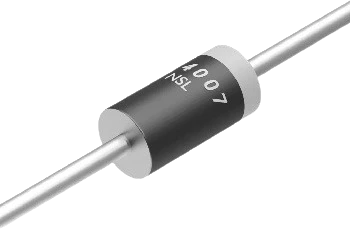
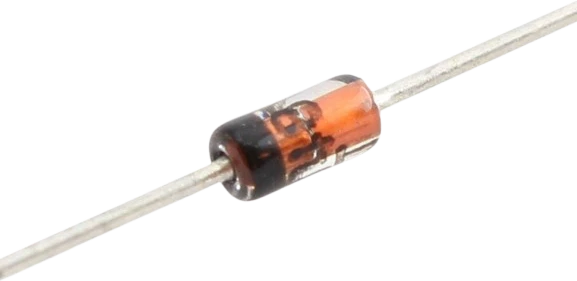
They do different jobs: the 1N4007 is a power rectifier rated 1.0 A average, 1000 V reverse and a 30 A surge (Vishay 1N4001 to 1N4007 datasheet, p. 1), while the 1N4148 is a small-signal switching diode rated 150 mA average and 75 V continuous that recovers in 4 ns (Vishay 1N4148 datasheet, pp. 1, 2). Use the 1N4007 for supplies, reverse-polarity protection and flyback across relays and motors, and the 1N4148 for logic, clamping and key matrices.
Side by side
| 1N4007 | 1N4148 | |
|---|---|---|
| TypeVishay 1N4001-1N4007 datasheet, p. 1; Vishay 1N4148 datasheet rev 1.6, p. 1 | General-purpose plastic rectifier | Small-signal fast switching diode (1N914 equivalent) |
| Reverse voltageVishay 1N4001-1N4007 datasheet, p. 1; Vishay 1N4148 datasheet rev 1.6, p. 1 | 1000 V repetitive peak (700 V RMS) | 100 V repetitive peak, 75 V continuous |
| Average forward currentVishay 1N4001-1N4007 datasheet, p. 1; Vishay 1N4148 datasheet rev 1.6, p. 1 | 1.0 A (9.5 mm leads, 75 °C) | 150 mA |
| Surge currentVishay 1N4001-1N4007 datasheet, p. 1; Vishay 1N4148 datasheet rev 1.6, p. 1 | 30 A, 8.3 ms half sine | 2 A for 1 µs |
| Forward voltageVishay 1N4001-1N4007 datasheet, p. 2; Vishay 1N4148 datasheet rev 1.6, p. 2 | 1.1 V max at 1.0 A | 1 V max at 10 mA |
| Reverse recoveryVishay 1N4001-1N4007 datasheet, p. 1; Vishay 1N4148 datasheet rev 1.6, p. 2 | Not specified (general-purpose rectification) | 4 ns max (IF = 10 mA, VR = 6 V) |
| CapacitanceVishay 1N4001-1N4007 datasheet, p. 2; Vishay 1N4148 datasheet rev 1.6, p. 2 | 15 pF typ at 4 V, 1 MHz | 4 pF max at 0 V, 1 MHz |
| Reverse leakageVishay 1N4001-1N4007 datasheet, p. 2; Vishay 1N4148 datasheet rev 1.6, p. 2 | 5 µA max at 1000 V, 25 °C | 25 nA max at 20 V |
| PackageVishay 1N4001-1N4007 datasheet, p. 1; Vishay 1N4148 datasheet rev 1.6, p. 1 | DO-41 (DO-204AL) molded plastic, band = cathode | DO-35 (DO-204AH) glass, black band = cathode |
Which one to pick
- Flyback diodes across relay coils, motors and solenoids: 1.0 A average and a 30 A surge (Vishay 1N4001-1N4007 datasheet, p. 1).
- Reverse-polarity protection in series with a supply under 1 A.
- 50/60 Hz rectification in power supplies, up to 1000 V reverse.
- Diode-OR and diode-AND logic, and keyboard matrices that need anti-ghosting.
- Clamping a signal or an ADC input to a rail: 4 pF and 4 ns keep edges clean (Vishay 1N4148 datasheet, p. 2).
- Fast or high-frequency signal paths, where a rectifier's slow recovery and 15 pF smear the edges.
Swapping one for the other
What changes in the wiring and the code.
- Polarity marking is the same: the band is the cathode on both (Vishay 1N4007 and 1N4148 datasheets, p. 1). Both are axial, but the DO-41 body of the 1N4007 is larger than the 1N4148's DO-35 glass, so check the hole pitch on a PCB.
- Replacing a 1N4148 with a 1N4007 works in slow signal circuits as long as the extra 15 pF and the unspecified recovery time do not matter; it is wrong in fast switching or RF paths.
- Replacing a 1N4007 with a 1N4148 only works when the current stays within 150 mA average and the reverse voltage under 75 V (Vishay 1N4148 datasheet, p. 1). Never put a 1N4148 across a motor or on a mains rectifier.
- Recheck voltage drops: up to 1.1 V at 1 A on the 1N4007 and up to 1 V at 10 mA on the 1N4148 (Vishay datasheets, p. 2). On 3.3 V rails that loss decides whether the circuit still works.
1N4007 or 1N4148: questions
Can I use a 1N4148 instead of a 1N4007?
Only in low-current signal circuits. The 1N4148 is rated 150 mA average and 75 V continuous (Vishay 1N4148 datasheet, p. 1), against the 1N4007's 1.0 A and 1000 V (Vishay 1N4001-1N4007 datasheet, p. 1). On a supply, a motor or a mains rectifier it overheats and fails.
Which diode for a relay flyback?
The 1N4007: it carries 1.0 A average and a 30 A surge (Vishay datasheet, p. 1), more than any hobby relay coil, motor or solenoid returns at turn-off. Wire it across the coil with the band toward the positive supply.
Can I use a 1N4007 instead of a 1N4148 in a key matrix or logic circuit?
Usually yes for slow signals such as a scanned keyboard, since it blocks and conducts the same way. In fast circuits it is the wrong part: its datasheet specifies no recovery time and its capacitance is 15 pF typical (Vishay 1N4001-1N4007 datasheet, p. 2), against the 1N4148's 4 ns and 4 pF max (Vishay 1N4148 datasheet, p. 2).
Which diode has the lower forward voltage?
Neither by much. The datasheets give their maximums at different currents: 1 V at 10 mA for the 1N4148 and 1.1 V at 1.0 A for the 1N4007 (Vishay datasheets, p. 2). For a much lower drop, use a Schottky diode.
How do I tell them apart on the bench?
The 1N4148 comes in a small DO-35 glass body with a black band; the 1N4007 in a larger molded plastic DO-41 body with a printed band (Vishay datasheets, p. 1). In both the band marks the cathode, and the printed number confirms which part it is.
The two references
Checked on 2026-10-29 against 2 sources, the makers’ datasheets first.
This comparison as plain Markdown. /compare/diode-1n4007-vs-diode-1n4148.md