Arduino Uno vs Nano
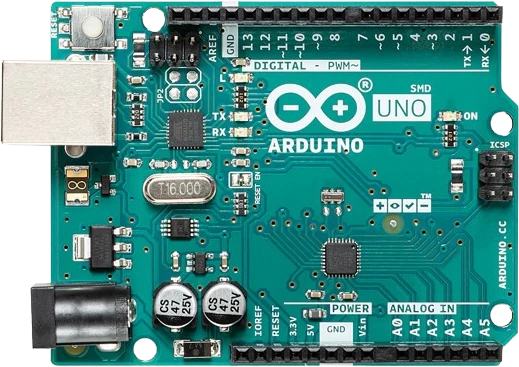
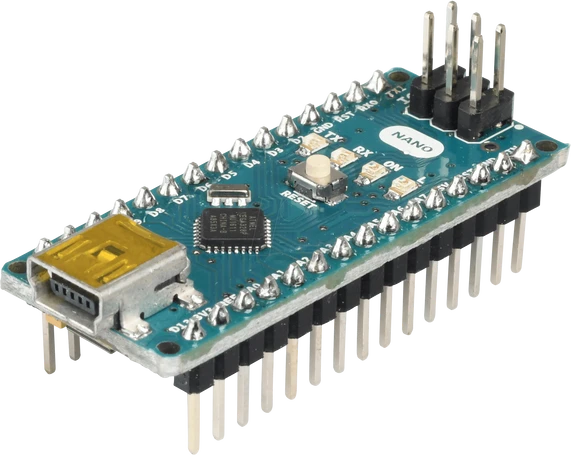
The Uno and the Nano run the same 5 V ATmega328P at 16 MHz with 32 KB of flash and 2 KB of SRAM, so the same sketch runs on both with the same pin numbers (Arduino UNO R3 tech specs; Arduino Nano tech specs). What differs is the board: the Nano is 18 × 45 mm and 7 g, plugs into a breadboard and adds two analog-only inputs, A6 and A7, while the Uno is 68.6 × 53.4 mm, takes shields and has a barrel jack (Arduino tech specs). Pick the Uno for shields and first projects, the Nano for breadboards and anything that must fit in a small box.
Side by side
| Arduino Uno | Nano | |
|---|---|---|
| MicrocontrollerArduino UNO R3 tech specs; Arduino Nano tech specs (A000005) | ATmega328P, 16 MHz, 5 V | ATmega328P, 16 MHz, 5 V |
| MemoryArduino UNO R3 tech specs; Arduino Nano datasheet (A000005), p. 2 | 32 KB flash (0.5 KB bootloader), 2 KB SRAM, 1 KB EEPROM | 32 KB flash (2 KB bootloader), 2 KB SRAM, 1 KB EEPROM |
| Digital I/OArduino UNO R3 tech specs; Arduino Nano tech specs | 14 (6 PWM: D3, D5, D6, D9, D10, D11) | 14 (6 PWM: D3, D5, D6, D9, D10, D11) |
| Analog inputsArduino UNO R3 tech specs; Arduino Nano store description; ATmega328P datasheet DS40002061B, p. 14 | 6 (A0 to A5) | 8 (A0 to A7; A6 and A7 analog only) |
| USB and bridgeArduino UNO R3 datasheet, pp. 2, 6; Arduino Nano tech specs; Nano V3.3 schematic | USB Type-B, ATmega16U2 | Mini-B USB, FTDI FT232RL |
| External powerArduino UNO R3 tech specs; Arduino Nano tech specs; Nano datasheet, p. 2 | Barrel jack or VIN, 7 to 12 V recommended | VIN 7 to 12 V recommended, or regulated 5 V on the 5V pin; no barrel jack |
| Current per I/O pinArduino UNO R3 tech specs; Arduino Nano tech specs | 20 mA recommended, 40 mA maximum | 20 mA recommended, 40 mA maximum |
| Size and weightArduino UNO R3 tech specs; Arduino Nano tech specs | 68.6 × 53.4 mm, 25 g | 18 × 45 mm, 7 g |
Which one to pick
- Shields: motor, relay, Ethernet and LCD shields plug straight onto the Uno's headers.
- Learning and quick tests with jumper wires, a barrel-jack adapter and a socketed chip on the classic R3.
- Bench setups powered from a 9 V or 12 V adapter through the barrel jack (7 to 12 V recommended, Arduino UNO R3 tech specs).
- Breadboard builds: the Nano straddles the center gap and every pin lands on its own row.
- Small, light enclosures and wearables: 18 × 45 mm and 7 g (Arduino Nano tech specs).
- Projects that need eight analog inputs, using A6 and A7 for analogRead() only (Nano store description).
Swapping one for the other
What changes in the wiring and the code.
- The code does not change: both boards use the ATmega328P at 16 MHz and the same pin numbers, with I2C on A4/A5 and SPI on D10 to D13.
- In the Arduino IDE select Arduino Nano instead of Arduino Uno. Many Nano clones need the processor set to 'ATmega328P (Old Bootloader)' and a CH340 driver.
- A6 and A7 on the Nano are analog inputs only (ATmega328P datasheet, p. 14); digitalRead() and digitalWrite() do nothing there.
- Power moves from the barrel jack to the Nano's VIN pin (7 to 12 V) or a regulated 5 V on its 5V pin (Arduino Nano tech specs). Keep light loads on the Nano's 3V3 pin, which comes from the FT232RL (Nano V3.3 schematic).
Arduino Uno or Nano: questions
Can I run the same code on an Arduino Uno and a Nano?
Yes. Both use the ATmega328P at 16 MHz and 5 V with the same pin numbering (Arduino UNO R3 tech specs; Nano tech specs). Select the matching board in the IDE before uploading; the sketch itself stays the same.
Does the Nano have more analog pins than the Uno?
Yes, eight against six. The extra A6 and A7 are wired only to the ADC (ATmega328P datasheet DS40002061B, p. 14), so use them with analogRead() and keep buttons and LEDs on the other pins.
Can a Nano use Uno shields?
Not directly: the Nano is 18 × 45 mm with two rows of pins (Nano tech specs), not the Uno header layout. Adapter boards exist that give a Nano the Uno footprint; otherwise wire the shield's parts on a breadboard.
How do I power a Nano without USB?
Put 7 V to 12 V on VIN, or a regulated 5 V on the 5V pin (Arduino Nano tech specs; Nano datasheet, p. 2). The Nano has no barrel jack, unlike the Uno.
Why won't my Nano clone upload when my Uno does?
Most clones use a CH340 USB chip and the older bootloader. Install the CH340 driver, then choose 'ATmega328P (Old Bootloader)' under Processor, and disconnect anything on D0 and D1.
The two references
Checked on 2026-10-29 against 4 sources, the makers’ datasheets first.
This comparison as plain Markdown. /compare/arduino-uno-vs-arduino-nano-v3.md