Capacitive Soil Moisture v1.2 with an Arduino Uno
A corrosion-resistant capacitive probe that reports soil moisture as a single analog voltage.
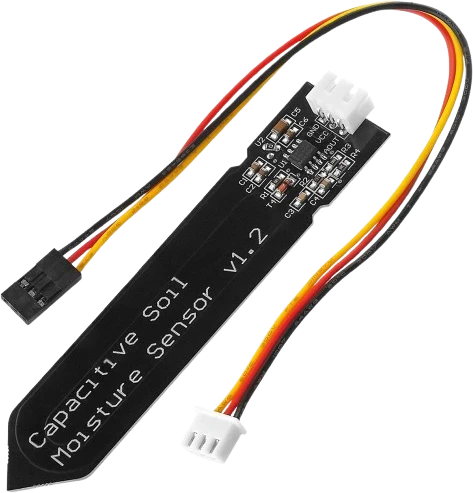
On an Arduino Uno the capacitive soil probe runs from 5V and its 0 V to 3.0 V output goes to A0. Because the Uno's ADC is referenced to its 5 V rail, the probe only uses about 60 % of the 0 to 1023 range, which is why the sketch's dry and wet values are 614 and 245.
Wiring the Capacitive Soil Moisture v1.2 to the Arduino Uno
Pin by pin.
| Capacitive Soil Moisture v1.2 | Arduino Uno |
|---|---|
| VCC | 5V |
| GND | GND |
| AOUT | A0 |
What to know on the Arduino Uno
- The probe's output tops out at 3.0 V, which reads about 614 on the Uno's 10-bit ADC referenced to 5 V (3.0 / 5 × 1024). Its wet reading near 1.2 V is about 245.DFRobot SEN0193 wiki, Specification; Microchip ATmega328P datasheet DS40002061B, p. 2
- The probe has its own regulator, so its output does not scale with the Uno's 5 V, while analogRead() does. If USB voltage sags, every reading shifts. Wiring the Uno's 3.3V pin to AREF and calling analogReference(EXTERNAL) both stabilises the reference and spreads 0 to 3.0 V over about 930 counts; recalibrate dry and wet after the change.DFRobot SEN0193 wiki, Specification; Arduino language reference, analogReference()
- Call analogReference(EXTERNAL) before the first analogRead() whenever a voltage is wired to AREF: Arduino warns that reading with the default reference while AREF is driven can damage the microcontroller.Arduino language reference, analogReference()
- The probe draws about 5 mA, so several of them on A0 to A3 are an easy load for the Uno's 5V pin.DFRobot SEN0193 wiki, Specification
Capacitive Soil Moisture v1.2 code for the Arduino Uno
Compiled for arduino:avr:uno on 2026-10-29.
// Capacitive Soil Moisture v1.2 on Arduino Uno: wiring and a free simulation at https://www.tinkered.ai/components/capacitive-soil-moisture-v12/arduino-uno
// Capacitive soil moisture: analogRead + calibrated percent.
// Calibration constants are auto-selected per board (see the table above).

const int SOIL_PIN = A0;          // Arduino: A0-A5 | ESP32: an ADC1 GPIO (e.g. 34)

#if defined(ESP32)
const int DRY_VALUE = 3723;       // ~3.0V on a 12-bit ESP32 ADC (sensor in air)
const int WET_VALUE = 1489;       // ~1.2V (sensor in water)
#else
const int DRY_VALUE = 614;        // ~3.0V on a 10-bit Uno ADC (sensor in air)
const int WET_VALUE = 245;        // ~1.2V (sensor in water)
#endif

void setup() {
  Serial.begin(9600);
}

void loop() {
  int raw = analogRead(SOIL_PIN);
  // round() (not map(): map() truncates and reads ~1% low)
  int moisture = round((float)(raw - DRY_VALUE) * 100.0 / (WET_VALUE - DRY_VALUE));
  moisture = constrain(moisture, 0, 100);
  Serial.print("Raw ADC: ");
  Serial.print(raw);
  Serial.print(" | Moisture: ");
  Serial.print(moisture);
  Serial.println(" %");
  delay(500);
}
Capacitive Soil Moisture v1.2 on the Arduino Uno: questions
Why does my soil sensor never read above about 614 on the Arduino Uno?
The probe outputs at most 3.0 V (DFRobot SEN0193 wiki), and the Uno's ADC maps 5 V to 1023, so 3.0 V reads about 614. That is normal; calibrate between your dry and wet readings.
Should I power the capacitive soil sensor from 5V or 3.3V on the Uno?
Either works, since it takes 3.3 V to 5.5 V and has its own regulator. 5V is the usual choice; the output range is the same 0 V to 3.0 V.
How can I get more resolution from the soil sensor on an Uno?
Wire the Uno's 3.3V pin to AREF and call analogReference(EXTERNAL) in setup(), before any analogRead(). The 0 V to 3.0 V output then spans about 930 counts instead of 614, and readings stop following the USB voltage. Recalibrate the dry and wet values afterwards.
Keep going
This guide as plain Markdown. /components/capacitive-soil-moisture-v12/arduino-uno.md