HC-SR501 vs RCWL-0516
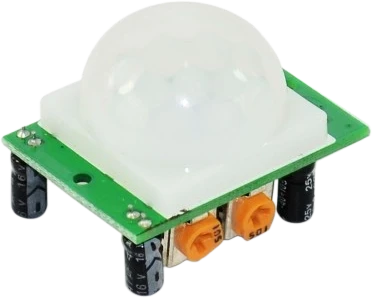
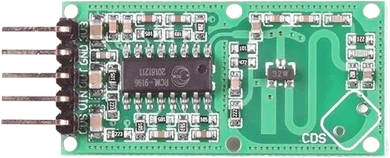
The HC-SR501 is a passive infrared sensor that sees moving body heat through a lens, idles under 50 µA and has adjustable range (about 3 to 7 m) and hold time (about 5 to 300 s) (HC-SR501 module datasheet). The RCWL-0516 is a microwave Doppler radar around 3.18 GHz that sees any moving object through thin plastic, draws about 2.7 mA and holds its output for a fixed 2 s (SparkFun RCWL-0516 product specifications). Choose the PIR for battery life and people-only triggers, the radar when the sensor must hide inside a plastic enclosure.
Side by side
| HC-SR501 | RCWL-0516 | |
|---|---|---|
| SensesHC-SR501 module datasheet; SparkFun RCWL-0516 product specifications | Change in infrared from warm bodies (passive) | Doppler shift of its own microwave signal from any moving object |
| RangeHC-SR501 module datasheet; SparkFun RCWL-0516 product specifications | About 3 to 7 m, set by a potentiometer | About 5 to 7 m |
| FieldHC-SR501 module datasheet; SparkFun RCWL-0516 product specifications | Cone of less than 120° | Not stated by the maker; sees through thin non-metal walls |
| SupplyHC-SR501 module datasheet; SparkFun RCWL-0516 product specifications | 4.5 V to 20 V | 4 V to 28 V |
| CurrentHC-SR501 module datasheet; SparkFun RCWL-0516 product specifications | Under 50 µA static | About 2.7 mA |
| OutputHC-SR501 module datasheet; SparkFun RCWL-0516 product specifications | 3.3 V high on motion | 3.3 V high on motion |
| Hold timeHC-SR501 module datasheet; SparkFun RCWL-0516 product specifications; Desbonnet RCWL-0516 notes | About 5 to 300 s by potentiometer; repeatable or single trigger by jumper | About 2 s fixed (a capacitor on the C-TM pad lengthens it) |
| Start-upHC-SR501 module datasheet; SparkFun RCWL-0516 product specifications | About 1 minute to initialize, may trigger up to three times | No warm-up period stated |
| Through glass or plasticHC-SR501 module datasheet; SparkFun RCWL-0516 product specifications | No: glass blocks the far infrared it sees | Yes through thin plastic; metal blocks it |
Which one to pick
- Battery-powered alarms and lights: under 50 µA at rest (HC-SR501 module datasheet).
- People and animals only: it reacts to warm bodies, not to fans, curtains or motion behind a wall.
- Adjustable behaviour without code: range from about 3 to 7 m and a hold from about 5 to 300 s on its two potentiometers.
- Hidden installs: microwaves pass through a plastic enclosure, so no lens or hole is needed (SparkFun RCWL-0516 product specifications).
- Places where heat and light vary, such as near heaters, windows or in hot rooms, which disturb a PIR.
- A tiny board on a wide supply, 4 V to 28 V, with a short 2 s pulse per detection.
Swapping one for the other
What changes in the wiring and the code.
- The three main wires stay the same: VCC or VIN to 5 V, GND, and OUT to any digital input; both drive OUT to 3.3 V, so no pull-up or level shifter is needed on 3.3 V or 5 V boards.
- Leave the RCWL-0516's 3V3 pin (an output) and CDS pin (a light-sensor input) unconnected for always-on operation.
- Rework the timing: the RCWL-0516 holds OUT for about 2 s per detection, the HC-SR501 for its delay setting, up to about 300 s. Code that relied on the PIR's long hold must keep its own timer.
- Drop the PIR's one-minute start-up delay, and expect the radar to trigger on fans, curtains and people behind thin walls; keep metal at least 1 cm from the back of its board.
HC-SR501 or RCWL-0516: questions
Which motion sensor has fewer false triggers?
The HC-SR501 indoors, because it only reacts to moving heat; its false triggers come from warm air, lights on the lens and the first minute after power-up (HC-SR501 module datasheet). The RCWL-0516 reacts to anything that moves, including fans, curtains and people beyond a thin wall.
Can either sensor see through a wall or a window?
The RCWL-0516 sees through thin plastic and other non-metal materials (SparkFun RCWL-0516 product specifications). The HC-SR501 cannot see through glass, which blocks the far infrared it senses.
Which uses less power?
The HC-SR501: under 50 µA static (HC-SR501 module datasheet), against about 2.7 mA for the RCWL-0516 (SparkFun product specifications).
Do they work with an ESP32 or Raspberry Pi Pico?
Yes. Both output 3.3 V, which goes straight to a GPIO. Power both from the board's 5 V or VIN pin: the HC-SR501 needs 4.5 V or more and the RCWL-0516 4 V or more.
Do either detect a person sitting still?
Not reliably. Both react to motion: the PIR to moving heat, the RCWL-0516 to the Doppler shift of something moving. For a still occupant use a 24 GHz presence radar such as the LD2410C.
The two references
Checked on 2026-10-29 against 3 sources, the makers’ datasheets first.
This comparison as plain Markdown. /compare/pir-hc-sr501-vs-rcwl-0516.md