LD2410C vs PIR HC-SR501
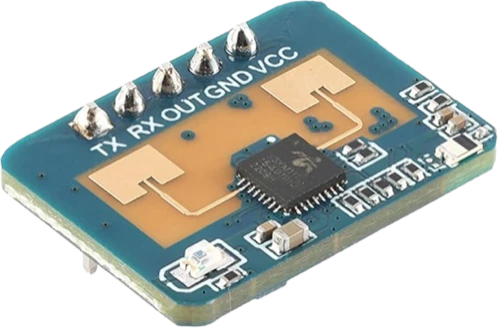
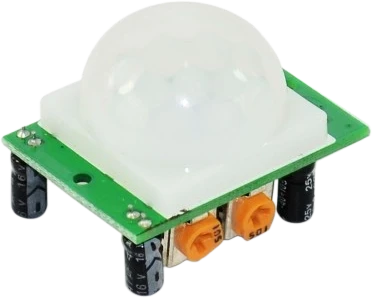
The LD2410C detects people who sit or lie still, because its 24 GHz FMCW radar senses micro-movement out to about 5 m across ±60°, where the HC-SR501 PIR only sees warm bodies moving through its cone of less than 120° (Hi-Link LD2410C user manual V1.00, pp. 3, 4, 17; HC-SR501 module datasheet). The price is power: the LD2410C averages 79 mA and asks for a 5 V supply that can give more than 200 mA, against under 50 µA for the PIR (Hi-Link manual, pp. 8, 17). Use the LD2410C to keep lights on in occupied rooms, the HC-SR501 for battery motion alarms.
Side by side
| LD2410C | PIR HC-SR501 | |
|---|---|---|
| SensesHi-Link LD2410C user manual V1.00, pp. 3, 4; HC-SR501 module datasheet | Moving and stationary people by 24 GHz FMCW radar | Moving warm bodies by passive infrared |
| RangeHi-Link LD2410C user manual V1.00, pp. 3, 17; HC-SR501 module datasheet | Up to 5 m (0.75 to 6 m adjustable in the parameter table), 0.75 m gates | About 3 to 7 m, set by a potentiometer |
| FieldHi-Link LD2410C user manual V1.00, p. 17; HC-SR501 module datasheet | ±60° | Cone of less than 120° |
| SupplyHi-Link LD2410C user manual V1.00, pp. 7, 8; HC-SR501 module datasheet | 5 V recommended (5 to 12 V), source able to give more than 200 mA | 4.5 V to 20 V |
| CurrentHi-Link LD2410C user manual V1.00, p. 17; HC-SR501 module datasheet | 79 mA average | Under 50 µA static |
| OutputsHi-Link LD2410C user manual V1.00, pp. 7, 8; HC-SR501 module datasheet | OUT (3.3 V, high when present) and UART at 256000 baud with distance and gate energy | OUT (3.3 V, high on motion) |
| TuningHi-Link LD2410C user manual V1.00, pp. 8, 13; HC-SR501 module datasheet | Farthest gate, per-gate sensitivity 0 to 100 and no-one hold time, over UART or Bluetooth app; saved at power-off | Two potentiometers (range, 5 to 300 s hold) and a trigger-mode jumper |
| Affected byHi-Link LD2410C user manual V1.00, pp. 4, 10 to 12; HC-SR501 module datasheet | Fans, curtains, pets, vibration of the module; not by temperature or light | Moving warm air, lights on the lens; cannot see through glass |
| Through a caseHi-Link LD2410C user manual V1.00, p. 12; HC-SR501 module datasheet | Yes, through a non-metal casing that passes 24 GHz | No, needs its Fresnel lens in open view |
Which one to pick
- Occupancy that must hold while people sit at a desk, watch TV or sleep: it senses stationary and micro-moving people (Hi-Link LD2410C user manual V1.00, p. 4).
- Home Assistant and ESPHome presence, with distance and per-gate energy over the 256000-baud UART (p. 8).
- Hidden installs behind a plastic cover, unaffected by room temperature or light (pp. 4, 12).
- Battery motion alarms and lights: under 50 µA at rest (HC-SR501 module datasheet).
- Fast walk-in triggers on a single digital pin, tuned by two knobs with no code.
- Rooms with fans, curtains or pets moving, which a radar picks up and a PIR ignores.
Swapping one for the other
What changes in the wiring and the code.
- For simple presence the wiring stays three wires: VCC to 5 V, GND, OUT to a digital input. Both drive OUT to 3.3 V, which 3.3 V and 5 V boards read as high (Hi-Link manual, p. 8; HC-SR501 module datasheet).
- Size the 5 V rail: the LD2410C wants a supply able to give more than 200 mA (Hi-Link manual, p. 8), not the PIR's microamps.
- For distance data, wire the LD2410C's TX and RX to a hardware UART at 256000 baud, 8N1 (p. 8); SoftwareSerial on an Uno is not reliable at that rate, and a 5 V board's TX must be dropped to 3.3 V before the sensor's RX.
- Expect OUT to stay high while anyone is in the room and for the no-one hold time after they leave (p. 8); shorten it or lower far-gate sensitivity if it never turns off.
- Drop the PIR's one-minute warm-up delay from your code.
LD2410C or PIR HC-SR501: questions
Does the LD2410C detect someone sitting still?
Yes. Its radar senses stationary and micro-moving people as well as moving ones, and is not affected by temperature or brightness (Hi-Link LD2410C user manual V1.00, p. 4). A PIR such as the HC-SR501 only reacts to heat that moves across its view.
Which is better for battery power?
The HC-SR501, at under 50 µA static (HC-SR501 module datasheet). The LD2410C averages 79 mA (Hi-Link manual, p. 17), which empties a battery quickly.
Can I replace a PIR with an LD2410C without changing code?
For a simple on/off trigger, yes: read OUT with digitalRead() as before, since it is a 3.3 V high when someone is present (Hi-Link manual, p. 8). Give it a stronger 5 V supply, and expect it to stay high while people sit still.
Why does my LD2410C never switch off?
It keeps reporting presence for the no-one duration after a person leaves, and fans, curtains or pets also trigger it (Hi-Link manual, pp. 8, 12). Shorten the no-one duration, lower far-gate sensitivity, or set unused gates to 100.
Can I use both together?
Yes, and it is a common pairing: the PIR's quick reaction switches a light on as someone walks in, and the LD2410C keeps it on while they sit still. Both outputs are 3.3 V digital lines on any GPIO.
The two references
Checked on 2026-10-29 against 2 sources, the makers’ datasheets first.
This comparison as plain Markdown. /compare/ld2410c-mmwave-radar-vs-pir-hc-sr501.md