DHT22 vs BME280
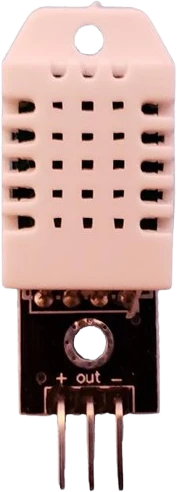
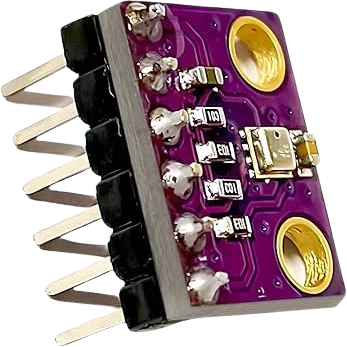
The BME280 adds barometric pressure, talks I2C so it shares two pins with other sensors, and can be read every second, where the DHT22 needs a pin of its own and 2 s between reads (Bosch BME280 datasheet rev 1.24, p. 2; Aosong AM2302/DHT22 datasheet, p. 3). Humidity and temperature are specified close: ±2 %RH (±5 %RH max) and ±0.5 °C for the DHT22, ±3 %RH from 20 to 80 %RH and ±0.5 °C at 25 °C for the BME280 (DHT22 datasheet, p. 1; BME280 datasheet, pp. 2, 12). For battery projects the BME280 wins clearly, at 3.6 µA sampling once a second against the DHT22's 1 to 1.5 mA while measuring (BME280 datasheet, p. 2; DHT22 datasheet, p. 5).
Side by side
| DHT22 | BME280 | |
|---|---|---|
| MeasuresAosong AM2302/DHT22 datasheet, p. 1; Bosch BME280 datasheet rev 1.24, p. 2 | Humidity, temperature | Humidity, temperature, pressure (300 to 1100 hPa) |
| HumidityAosong AM2302/DHT22 datasheet, p. 1; Bosch BME280 datasheet rev 1.24, pp. 2, 9 | 0 to 100 %RH, ±2 %RH (±5 %RH max), 0.1 %RH resolution | 0 to 100 %RH, ±3 %RH (20 to 80 %RH at 25 °C), 1 s response |
| TemperatureAosong AM2302/DHT22 datasheet, p. 1; Bosch BME280 datasheet rev 1.24, p. 12 | -40 to 80 °C, ±0.5 °C | -40 to +85 °C, ±0.5 °C at 25 °C |
| InterfaceAosong AM2302/DHT22 datasheet, p. 2; Bosch BME280 datasheet rev 1.24, p. 2 | Own single-wire timing protocol, one GPIO per sensor | I2C up to 3.4 MHz or SPI up to 10 MHz |
| Fastest readingAosong AM2302/DHT22 datasheet, p. 3; Bosch BME280 datasheet rev 1.24, p. 2 | 2 s minimum between reads | No 2 s limit; its current is quoted at 1 Hz with humidity in 1 s response |
| SupplyAosong AM2302/DHT22 datasheet, pp. 1, 2; Bosch BME280 datasheet rev 1.24, p. 2 | 3.3 V to 5.5 V | Chip 1.71 V to 3.6 V; the GY-BME280-5V module takes 3.3 V or 5 V through its regulator, the 3.3 V version 3.3 V only |
| CurrentAosong AM2302/DHT22 datasheet, p. 5; Bosch BME280 datasheet rev 1.24, p. 2 | 1 to 1.5 mA measuring, 40 to 50 µA standby | 3.6 µA at 1 Hz (all three channels), 0.1 µA sleep |
| AddressAosong AM2302/DHT22 datasheet, p. 2; Bosch BME280 datasheet rev 1.24, p. 32 | None: one sensor per pin | 0x76 (SDO low) or 0x77 (SDO high), two per bus |
Which one to pick
- A first humidity project with three wires and the DHT library, on any 3.3 V or 5 V board (Aosong AM2302/DHT22 datasheet, pp. 1, 2).
- When the I2C pins are already taken, or the sensor sits on a cable away from the board: it only needs one free GPIO.
- Humidity read straight in 0.1 %RH steps with ±2 %RH typical accuracy (p. 1), with no pressure channel to pay for.
- Weather stations that want pressure for forecasting or altitude as well as humidity and temperature (Bosch BME280 datasheet, p. 2).
- Battery and solar nodes: 3.6 µA at 1 Hz and 0.1 µA in sleep (p. 2).
- Projects that already use an I2C display or other I2C sensors, or need readings faster than every 2 seconds.
Swapping one for the other
What changes in the wiring and the code.
- Rewire from one data pin to I2C: the BME280's SDA and SCL go to the board's I2C pins, and its DATA pull-up is no longer needed; the GY-BME280 module carries its own I2C pull-ups.
- Swap the library: Adafruit_BME280 with bme.begin(0x76) replaces DHT dht(PIN, DHT22). The read calls become bme.readTemperature(), bme.readHumidity() and bme.readPressure().
- Remove the 2 s delay the DHT22 needed (DHT22 datasheet, p. 3); the BME280 can be read in every loop.
- Mind the supply on bare boards: the DHT22 takes 3.3 V to 5.5 V, the BME280 chip only 1.71 V to 3.6 V (BME280 datasheet, p. 2), so 5 V is only safe on a breakout with a regulator.
- Tie CSB high for I2C: a low pulse on it switches the BME280 to SPI until power is cycled (p. 32).
DHT22 or BME280: questions
Is the BME280 more accurate than the DHT22?
Not on paper for humidity: the DHT22 is specified at ±2 %RH typical, ±5 %RH max (Aosong AM2302/DHT22 datasheet, p. 1), the BME280 at ±3 %RH from 20 to 80 %RH at 25 °C (Bosch BME280 datasheet, p. 9). Temperature is ±0.5 °C on both. The BME280's advantages are pressure, I2C and far lower power.
Can the BME280 replace a DHT22 in my sketch?
Yes, but the wiring and library change: the BME280 is an I2C device at 0x76 or 0x77 (BME280 datasheet, p. 32), while the DHT22 uses its own one-wire timing protocol (DHT22 datasheet, p. 2). Replace the DHT library calls with Adafruit_BME280's readTemperature() and readHumidity().
Which uses less power?
The BME280: 3.6 µA sampling all channels once a second and 0.1 µA asleep (BME280 datasheet, p. 2), against 1 to 1.5 mA measuring and 40 to 50 µA standby for the DHT22 (DHT22 datasheet, p. 5).
Why does my BME280 read warmer than my DHT22?
Bosch notes the BME280's temperature includes PCB heat and self-heating and is typically above ambient (BME280 datasheet, p. 12). Use forced mode or slow sampling and keep the board away from regulators and the microcontroller.
Can I use both on an ESP32?
Yes. Power the DHT22 from 3.3 V so its DATA line stays at 3.3 V (it runs from 3.3 V to 5.5 V, DHT22 datasheet, p. 2), and wire the BME280 to the ESP32's I2C pins; its 1.2 V to 3.6 V interface supply matches 3.3 V logic (BME280 datasheet, p. 2).
The two references
Checked on 2026-10-29 against 2 sources, the makers’ datasheets first.
This comparison as plain Markdown. /compare/dht22-vs-bme280.md